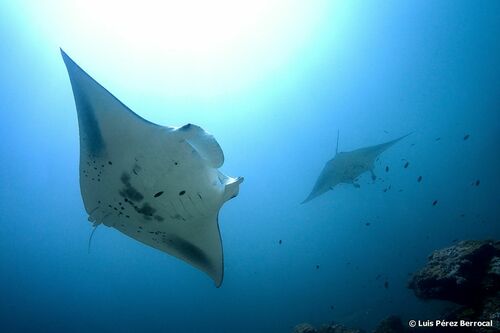


Reef Manta Ray
mobula alfredi
The Reef Manta Ray is one of the ocean's most charismatic and graceful giants. Gliding effortlessly through tropical and subtropical coastal waters, these gentle filter-feeders capture the imagination of divers and marine biologists alike. Unlike their larger pelagic relatives, reef manta rays are highly social and are frequently spotted visiting coastal reefs, shallow bays, and underwater cleaning stations where smaller fish groom them. They possess some of the largest brains relative to body size of any fish, exhibiting complex behaviors, curiosity, and individual recognition.
Hábitat: Typically found in shallow, coastal waters of tropical and subtropical oceans, often near coral reefs, lagoons, and productive islands.
Reef manta rays feature a flattened, diamond-shaped body with wide, triangular pectoral fins and a pair of forward-pointing cephalic horns on either side of their wide, terminal mouth. Their dorsal side is typically dark black or grey, often showcasing a prominent Y- or V-shaped pale shoulder marking, while their belly is predominantly white with a unique constellation of dark spots that serves as an individual fingerprint. On average, their wingspan ranges from 300 to 350 centimeters, though exceptional individuals can reach up to 500 centimeters.
Categoría
AnimalRareza
Common
Peligro
1/5 · Muy bajo
Snaps
¡Sé la primera persona en hacer un snap!
Reef manta rays have one of the highest brain-to-body mass ratios of all fish, showing indicators of high intelligence, self-awareness, and intense curiosity.
Their unique belly spots act exactly like human fingerprints, allowing researchers to track individual mantas for decades using non-invasive photography.
They perform beautiful, synchronized underwater 'somersaults' called barrel rolling to maximize their intake of dense plankton patches.
Unlike stingrays, reef manta rays do not possess a venomous tail spine and are completely harmless to humans.
They use flexible, horn-like cephalic fins to channel plankton-rich water directly into their wide mouths while feeding.
Each manta ray possesses a completely unique pattern of spots on its belly, which acts like a biological fingerprint.
They exhibit complex social dynamics, regularly visiting specific shallow cleaning stations where cleaner wrasses remove parasites and dead skin.
Feeds almost exclusively on tiny zooplankton filtered from the water column using specialized gill rakers.
Diferencias por edad: Juveniles typically forage in protected, shallow nursery lagoons before venturing to deeper, high-current reefs as adults.
Labroides dimidiatus
Provides food removal services; cleaner fish remove parasites and dead skin from the manta's body at cleaning stations.
Echeneis naucrates
Attaches to the manta ray to hitchhike, feed on scraps, and eat parasites.
Galeocerdo cuvier
A primary predator of the reef manta ray, especially targeting juveniles and injured adults.
Aún no hay insignias de rasgos asignadas a este objeto.
Todavía no hay alias listados.
Las colecciones para este objeto aparecerán aquí a medida que se añadan más temas.
Peligro
1/5 · Muy bajo
Todavía no hay notas especiales de seguridad.
La forma más fácil de identificar a Reef Manta Ray es usar la aplicación de identificación de naturaleza Snappit.
200+ cm
300+ cm
500+ kg
30+ años
24 km/h
Feeds almost exclusively on tiny zooplankton filtered from the water column using specialized gill rakers.
Typically found in shallow, coastal waters of tropical and subtropical oceans, often near coral reefs, lagoons, and productive islands.
Acércate para separar los grupos y explorar dónde se ha fotografiado este objeto.
Los snaps recientes aparecerán aquí a medida que se añadan nuevas observaciones.