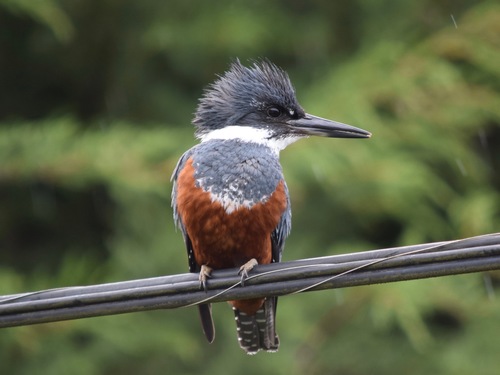


Ringed Kingfisher
megaceryle torquata
The Ringed Kingfisher is a spectacular, noisy, and conspicuous bird of prey that dominates waterways across the Neotropics and the southernmost tip of Texas. As the largest kingfisher in the Americas, it commands attention with its loud, rattling call and dramatic fishing style. It spends hours patiently perched on high, exposed branches overlooking rivers, lakes, and coastal lagoons, waiting for the perfect moment to plunge-dive into the water below. Its remarkable nesting behavior involves both parents excavating long tunnels deep into dirt banks, where they raise their young in safety. This hardy and adaptable bird is a key indicator of healthy, fish-rich aquatic ecosystems.
Hábitat: Typically found along large rivers, lake margins, mangrove swamps, and coastal lagoons where calm, fish-rich waters are present.
This large, stocky bird is easily identified by its massive, dagger-like black bill and prominent shaggy crest. Its upperparts and head are a uniform slate-blue, contrasted sharply by a broad white collar. Males feature a rich rufous belly and breast, while females are distinguished by a slate-blue band across the upper chest, followed by a narrow white band and a rufous belly. It is noticeably larger than other American kingfishers, measuring around 40 centimeters in length.
Categoría
AvesRareza
Common
Peligro
1/5 · Muy bajo
Snaps
¡Sé la primera persona en hacer un snap!
Instead of using soft nesting materials, these birds lay their eggs directly on the bare dirt or on a bed of regurgitated fish bones at the end of their burrow.
It is the largest species of kingfisher found in the Americas, easily dwarfing the belted kingfisher.
They use their heavy bills like shovels to excavate nesting tunnels, a task that both the male and female birds share.
Launches steep dives from high perches, entering the water headfirst at high speeds to grab fish deep beneath the surface.
Capable of hovering stationary in mid-air over open water to locate prey before executing a vertical dive.
Uses its heavy, powerful bill and fused toes to dig nesting tunnels up to eight feet deep into vertical dirt banks.
Feeds almost exclusively on fish, supplemented occasionally by crustaceans, amphibians, and large aquatic insects.
Astyanax mexicanus
Dives into freshwater systems to catch this common schooling fish.
Nannopterum brasilianum
Competes for prime fishing perches and overlapping fish prey in shallow waters.
Ctenosaura similis
Occasionally raids the kingfisher's riverbank burrow nests to consume eggs and hatchlings.
Aún no hay insignias de rasgos asignadas a este objeto.
Todavía no hay alias listados.
Las colecciones para este objeto aparecerán aquí a medida que se añadan más temas.
Peligro
1/5 · Muy bajo
Todavía no hay notas especiales de seguridad.
La forma más fácil de identificar a Ringed Kingfisher es usar la aplicación de identificación de naturaleza Snappit.
38-41 cm
75-83 cm
0.3-0.45 kg
5-10 años
50 km/h
Feeds almost exclusively on fish, supplemented occasionally by crustaceans, amphibians, and large aquatic insects.
Typically found along large rivers, lake margins, mangrove swamps, and coastal lagoons where calm, fish-rich waters are present.
Acércate para separar los grupos y explorar dónde se ha fotografiado este objeto.
Los snaps recientes aparecerán aquí a medida que se añadan nuevas observaciones.












.jpg&width=800)



