

Rio Grande Leopard Frog
lithobates berlandieri
The Rio Grande Leopard Frog is a hardy, adaptable amphibian native to the arid and semi-arid regions of the southern United States and Mexico. Known for its striking spotted pattern, this resilient frog thrives in surprising places, ranging from desert springs and stock tanks to slow-moving streams and golf course ponds. Its melodic, rattling mating call is a hallmark of warm desert nights, signaling the start of its breeding cycle. Unlike many other amphibians that require pristine, undisturbed habitats, the Rio Grande Leopard Frog is exceptionally tolerant of brackish waters and mild human encroachment, allowing it to maintain stable populations in human-modified landscapes.
Hábitat: Found in and around permanent and semi-permanent water sources such as streams, rivers, springs, canals, and stock ponds within arid grasslands and thornscrub regions.
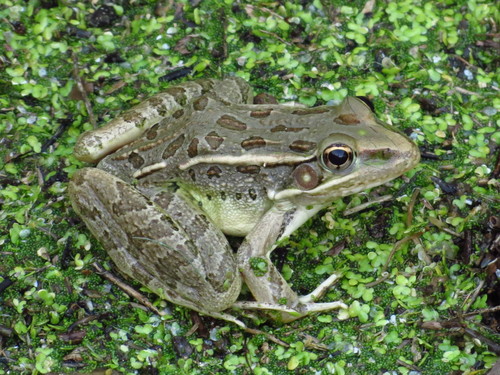
Sporting a highly distinctive camo pattern, the Rio Grande Leopard Frog features a pale green to tan or brown dorsum covered in large, irregular dark spots with light borders. A pair of prominent, light-colored dorsolateral folds runs down its back from behind the eyes to the lower body, emphasizing its streamlined shape. Its long, muscular hind legs are adorned with dark bands, built perfectly for powerful leaps, while its pale belly is usually clean white or cream.
Categoría
AnfibiosRareza
Common
Peligro
1/5 · Muy bajo
Snaps
¡Sé la primera persona en hacer un snap!
Their mating call is a complex sound that has been described as a series of low chuckles, clicks, and a long, guttural grunt.
This species has successfully colonized areas outside its native range, including parts of the Colorado River in Arizona and California, thanks to human-made canals.
Unlike some leopard frogs, this species can remain active year-round in the warm southernmost portions of its range, skipping winter hibernation entirely.
Unlike many amphibians, this species can tolerate slightly brackish or saline water, allowing it to colonize coastal areas and saline desert springs.
The bold, irregular dark spots on its green or brown skin disrupt its physical outline, making it virtually invisible among shoreline vegetation and muddy banks.
Possesses highly developed hind legs that allow it to launch into sudden, high-velocity jumps to evade predators, landing directly in the safety of deep water.
Primarily feeds on a wide variety of terrestrial and aquatic invertebrates, and is opportunistic enough to occasionally consume smaller vertebrates.
Diferencias por edad: As aquatic tadpoles, they are primarily herbivorous, scraping algae and organic detritus from underwater surfaces, transitioning to carnivorous insectivores after metamorphosis.
Procyon lotor
An opportunistic predator that frequently hunts these frogs along water shorelines at night.
Thamnophis marcianus
Commonly preys on both the tadpoles and adult frogs in riparian habitats.
Anax junius
Adult frogs readily consume large insects like dragonflies, while dragonfly nymphs may conversely prey on young tadpoles.
Aún no hay insignias de rasgos asignadas a este objeto.
Todavía no hay alias listados.
Las colecciones para este objeto aparecerán aquí a medida que se añadan más temas.
Peligro
1/5 · Muy bajo
Todavía no hay notas especiales de seguridad.
La forma más fácil de identificar a Rio Grande Leopard Frog es usar la aplicación de identificación de naturaleza Snappit.
5-11 cm
0.02-0.12 kg
2-5 años
10 km/h
Primarily feeds on a wide variety of terrestrial and aquatic invertebrates, and is opportunistic enough to occasionally consume smaller vertebrates.
Found in and around permanent and semi-permanent water sources such as streams, rivers, springs, canals, and stock ponds within arid grasslands and thornscrub regions.
Ambush
Acércate para separar los grupos y explorar dónde se ha fotografiado este objeto.
Los snaps recientes aparecerán aquí a medida que se añadan nuevas observaciones.