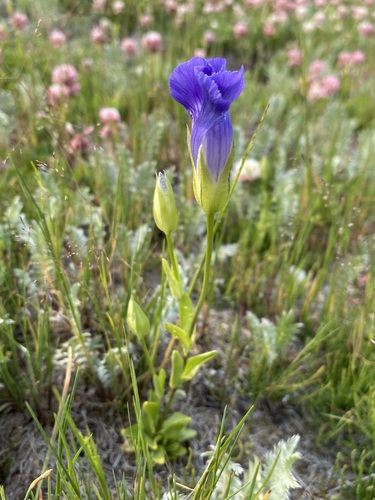


Rocky Mountain Fringed Gentian
gentianopsis thermalis
The Rocky Mountain Fringed Gentian is a stunning, deep-blue to purple wildflower native to the high-elevation wetlands, wet meadows, and thermal basin areas of the Rocky Mountains. Famous for being the official flower of Yellowstone National Park, this annual or biennial plant boasts showy, trumpet-shaped flowers with delicate, fringed petals. It blooms late in the season, typically from late July through September, offering a spectacular burst of color when many other subalpine wildflowers have already faded.
Hábitat: Found in wet subalpine meadows, seeps, and thermal areas of the Rocky Mountains, often in alkaline, mineral-rich soils.
This plant typically grows 10 to 40 cm tall, featuring erect, square stems with opposite, lance-shaped leaves. Its most striking feature is the solitary, deep violet-blue flower sitting atop each stem. The flower corolla is trumpet-shaped, ending in four spreading lobes that are finely fringed along their outer margins. When the sun is shining, the petals open wide to display their rich coloration, but they twist tightly shut on cloudy days or during cold evenings to protect their reproductive organs.
Categoría
PlantasRareza
Common
Peligro
1/5 · Muy bajo
Snaps
¡Sé la primera persona en hacer un snap!
Historically, Native American tribes used infusions made from gentian roots for various medicinal purposes, including treating digestive ailments.
It is the official flower of Yellowstone National Park, designated in 1926 due to its abundance near the park's famous geysers.
The flowers exhibit solar tracking behavior, twisting open in bright sunlight and closing up tightly when clouds obscure the sun.
The flower petals twist and close tightly at night or during overcast weather to shield delicate pollen from rain and frost.
Adapted to survive in the warm, mineral-rich runoff soils of geothermal basins without sustaining heat or chemical damage.
The delicate fringes along the petal edges help visually guide native bumblebee pollinators directly to the nectar reserves.
As a photosynthetic plant, it utilizes chlorophyll to synthesize sugars from carbon dioxide and sunlight, absorbing water and essential mineral nutrients through its root system.
Bombus bifarius
Pollinated by bumblebees seeking nectar, which triggers the release of pollen.
Cervus canadensis
Occasionally grazed upon by large native herbivores moving through wet meadows.
Aún no hay insignias de rasgos asignadas a este objeto.
Todavía no hay alias listados.
Las colecciones para este objeto aparecerán aquí a medida que se añadan más temas.
Peligro
1/5 · Muy bajo
Todavía no hay notas especiales de seguridad.
La forma más fácil de identificar a Rocky Mountain Fringed Gentian es usar la aplicación de identificación de naturaleza Snappit.
10-40 cm
1-2 años
As a photosynthetic plant, it utilizes chlorophyll to synthesize sugars from carbon dioxide and sunlight, absorbing water and essential mineral nutrients through its root system.
Found in wet subalpine meadows, seeps, and thermal areas of the Rocky Mountains, often in alkaline, mineral-rich soils.
Acércate para separar los grupos y explorar dónde se ha fotografiado este objeto.
Los snaps recientes aparecerán aquí a medida que se añadan nuevas observaciones.

















