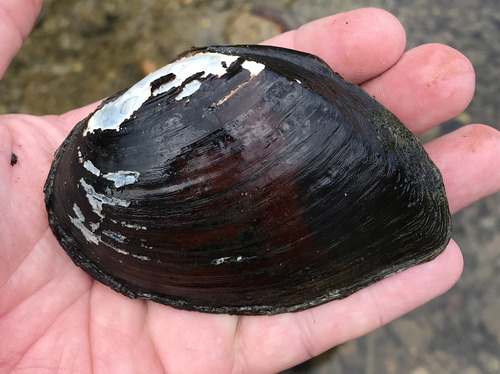
Rough Fatmucket
lampsilis straminea
The Rough Fatmucket (Lampsilis straminea) is a fascinating freshwater bivalve native to the river basins of the southeastern United States. Like many of its unionid relatives, this mussel leads a quiet, largely hidden life buried in the sandy or gravelly bottoms of streams and rivers. Despite its humble appearance, the Rough Fatmucket plays an extraordinary role in its aquatic ecosystem, serving as a natural filtration system that cleans the water while providing habitat structure for other river-dwelling organisms. What makes the Rough Fatmucket truly remarkable is its sophisticated reproductive strategy. Female mussels employ highly specialized, lifelike tissue lures that mimic small fish to attract larger predatory fish. When a curious fish strikes at the lure, the mussel releases its larvae, which temporarily attach to the fish's gills to hitchhike to new upstream habitats.
Hábitat: Found in small to medium rivers and slow-flowing streams, typically buried in sandy, gravelly, or muddy riverbeds.
The Rough Fatmucket features a solid, moderately inflated shell that is oval to elliptical in shape. Its outer shell layer, or periostracum, ranges from a dull yellowish-brown to a warmer reddish-brown, often adorned with faint green rays that radiate from the beak toward the outer edge. The shell surface is typically roughened by prominent growth lines, giving it a textured feel. Inside, the nacre (mother-of-pearl lining) is smooth and ranges in color from a bright, iridescent white to a delicate pinkish-white.
Categoría
InvertebrateRareza
Common
Peligro
1/5 · Muy bajo
Snaps
¡Sé la primera persona en hacer un snap!
Piles of discarded shells left by predators like muskrats on riverbanks are called 'middens' and are key indicators for researchers that a mussel population is nearby.
The female Rough Fatmucket can wiggle its lifelike mantle lure to simulate the swimming motion of a minnow, complete with convincing eyespots and 'fins' to trick predatory fish.
These mussels act as living water treatment plants; a single individual can filter up to several gallons of water a day, dramatically improving local water clarity.
The female displays a modified mantle flap that mimics a small prey fish, complete with eyespots and tail-flapping motions, to attract host fish for its larvae.
Can continuously pump and filter gallons of water daily, extracting organic particles and bacteria while purifying the surrounding river water.
Utilizes a muscular foot to burrow deep into gravel or sand, anchoring itself firmly against strong river currents.
As a filter feeder, it siphons river water to strain out microscopic organic material, phytoplankton, and bacteria.
Diferencias por edad: Juveniles primarily feed on interstitial organic matter and bacteria using their foot, while adults transition to filter feeding via siphons.
Micropterus salmoides
The glochidia (larvae) of the Rough Fatmucket temporarily attach to the gills of this host fish to complete their development and get dispersed upstream.
Ondatra zibethicus
Muskrats are major predators of freshwater mussels, harvesting them from shallow water and leaving piles of empty shells on the shorelines.
Aún no hay insignias de rasgos asignadas a este objeto.
Todavía no hay alias listados.
Las colecciones para este objeto aparecerán aquí a medida que se añadan más temas.
Peligro
1/5 · Muy bajo
Todavía no hay notas especiales de seguridad.
La forma más fácil de identificar a Rough Fatmucket es usar la aplicación de identificación de naturaleza Snappit.
0.05+ kg
As a filter feeder, it siphons river water to strain out microscopic organic material, phytoplankton, and bacteria.
Found in small to medium rivers and slow-flowing streams, typically buried in sandy, gravelly, or muddy riverbeds.
Filtering
Acércate para separar los grupos y explorar dónde se ha fotografiado este objeto.
Los snaps recientes aparecerán aquí a medida que se añadan nuevas observaciones.