

Round-Leaf Catchfly
silene rotundifolia
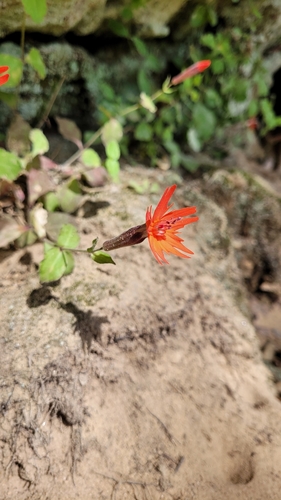
The Round-Leaf Catchfly (Silene rotundifolia) is a striking perennial wildflower native to the sandstone rock cliffs and shaded gorges of the Appalachian region in the southeastern United States. It stands out dramatically against its muted rocky backdrops due to its brilliant, star-like scarlet-red blossoms. The plant gets its common name, 'catchfly,' from the sticky, glandular hairs that cover its stems and foliage, which frequently trap small crawling insects. Although it ensnares bugs, the plant is not carnivorous; instead, this stickiness is thought to act as a defensive barrier against herbivores that might otherwise climb up to consume its delicate flowers and seeds. Highly specialized, it thrives in damp, sheltered microclimates where few other plants can take root, making it a true wonder of cliffside botanical survival.
Hábitat: Found exclusively on shaded sandstone rock ledges, cliff faces, and the damp, protected recesses of rock shelters.
This sprawling perennial reaches heights of 20 to 60 centimeters, featuring sticky, glandular-hairy stems and opposite, broadly rounded to egg-shaped green leaves. Its most defining feature is the vibrant scarlet to deep-red flowers, which measure about 2 to 3 centimeters across. Each of the five petals is deeply notched or two-cleft at the tip, giving the flower a fringed or star-like appearance. The tubular green calyx at the base of the petals is also heavily coated with sticky, clear droplets that glisten under close inspection.
Categoría
PlantasRareza
Common
Peligro
1/5 · Muy bajo
Snaps
¡Sé la primera persona en hacer un snap!
Although it efficiently traps insects on its sticky stems, the Round-Leaf Catchfly is not carnivorous and gains no nutrients from the trapped bugs.
Its brilliant red coloration is specifically targeted at hummingbirds, which have excellent red-spectrum vision, whereas most insect pollinators prefer blue or yellow.
The species name 'rotundifolia' refers to its round, spoon-shaped leaves, which are unusual for members of the pink family.
Stems and leaves are coated in sticky, glandular hairs that trap crawling insects, deterring potential herbivores from eating the flowers.
Possesses a highly specialized, fibrous root system that can wedge into extremely narrow crevices of sandstone cliffs to secure moisture and anchor the plant.
Adapted to optimize photosynthesis under the heavy canopy shade and rock shelter overhangs where direct sunlight is minimal.
Produces energy through photosynthesis using sunlight, carbon dioxide, and water, supplemented by mineral absorption from sparse crevice soils.
Archilochus colubris
Serves as the primary pollinator, attracted to the bright red, tubular flowers.
Heuchera parviflora
Competes for the limited soil, moisture, and space available in sandstone rock crevices.
Aún no hay insignias de rasgos asignadas a este objeto.
Todavía no hay alias listados.
Las colecciones para este objeto aparecerán aquí a medida que se añadan más temas.
Peligro
1/5 · Muy bajo
Todavía no hay notas especiales de seguridad.
La forma más fácil de identificar a Round-Leaf Catchfly es usar la aplicación de identificación de naturaleza Snappit.
20-60 cm
3-10 años
Produces energy through photosynthesis using sunlight, carbon dioxide, and water, supplemented by mineral absorption from sparse crevice soils.
Found exclusively on shaded sandstone rock ledges, cliff faces, and the damp, protected recesses of rock shelters.
Acércate para separar los grupos y explorar dónde se ha fotografiado este objeto.
Los snaps recientes aparecerán aquí a medida que se añadan nuevas observaciones.