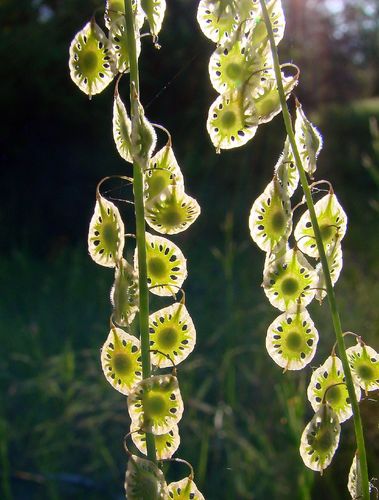


Sand Fringepod
thysanocarpus curvipes
The Sand Fringepod, scientifically known as Thysanocarpus curvipes, is a fascinating annual herb native to the diverse ecosystems of western North America. A member of the mustard family (Brassicaceae), this plant is often overlooked due to its modest size, yet it possesses unique features that make it a compelling subject for nature enthusiasts. It completes its entire life cycle, from seed to flower to seed, within a single growing season, making it a resilient colonizer of disturbed or ephemeral habitats. Its unassuming appearance belies a quiet efficiency in adaptation, thriving in conditions that many other plants would find challenging. The plant's common name and scientific epithet both point directly to its most distinguishing characteristic: its unusual, fringed seed pods.
Hábitat: This annual plant is typically found in dry, open woodlands, grasslands, chaparral, and disturbed areas like roadsides and clearings, often preferring sandy or gravelly soils.
The Sand Fringepod is a slender, erect annual herb typically growing 10 to 60 centimeters tall. Its stem is often sparsely branched. Basal leaves are usually lobed or pinnatifid and tend to wither early in the season, while the smaller, linear stem leaves clasp the stem. The flowers are minute, typically white or tinged with pinkish-purple, arranged in loose racemes at the top of the stem. The most striking visual identifier is its unique fruit: a flat, circular, disc-like silicle (seed pod) measuring about 5-8 mm in diameter, suspended from a distinctively curved stalk. These pods feature a prominent, often intricately toothed or ciliate (fringed) margin, giving the plant its common name.
Categoría
PlantasRareza
Common
Peligro
1/5 · Muy bajo
Snaps
¡Sé la primera persona en hacer un snap!
As a member of the Brassicaceae family, it is related to many economically important food crops such as cabbage, broccoli, and kale.
Despite its delicate appearance, Sand Fringepod is often considered a pioneer species, capable of colonizing disturbed areas like recent burns or construction sites.
The genus name 'Thysanocarpus' is derived from Greek words meaning 'fringe' (thysanos) and 'fruit' (karpos), a direct reference to its distinctive seed pods.
The species epithet 'curvipes' translates to 'curved foot,' aptly describing the short, curved stalks from which the unique fruits hang.
The distinctive disc-like fruits possess a fringed margin which may aid in anemochory (wind dispersal) or epizoochory (clinging to animal fur or feathers), allowing seeds to spread effectively across its habitat.
As an annual, the Sand Fringepod completes its entire life cycle within one year, enabling it to quickly colonize and reproduce in ephemeral or recently disturbed environments where competition may be lower.
Thrives in well-drained, often nutrient-poor sandy or gravelly soils, demonstrating an ability to withstand drier conditions common in its native semi-arid and Mediterranean climates.
As a green plant, the Sand Fringepod produces its own organic food through photosynthesis, converting sunlight, carbon dioxide from the atmosphere, and water absorbed from the soil into sugars for energy and growth. It also absorbs essential mineral nutrients from the soil.
Apiformes
Pollination for reproduction
Lepus californicus
Grazing on plant material
Various Bacteria and Fungi
Nutrient cycling and decomposition
Aún no hay insignias de rasgos asignadas a este objeto.
Todavía no hay alias listados.
Las colecciones para este objeto aparecerán aquí a medida que se añadan más temas.
Peligro
1/5 · Muy bajo
Todavía no hay notas especiales de seguridad.
La forma más fácil de identificar a Sand Fringepod es usar la aplicación de identificación de naturaleza Snappit.
10-60 cm
0.005-0.05 kg
0-1 años
As a green plant, the Sand Fringepod produces its own organic food through photosynthesis, converting sunlight, carbon dioxide from the atmosphere, and water absorbed from the soil into sugars for energy and growth. It also absorbs essential mineral nutrients from the soil.
This annual plant is typically found in dry, open woodlands, grasslands, chaparral, and disturbed areas like roadsides and clearings, often preferring sandy or gravelly soils.
Absorption And Photosynthesis
Acércate para separar los grupos y explorar dónde se ha fotografiado este objeto.
Los snaps recientes aparecerán aquí a medida que se añadan nuevas observaciones.















