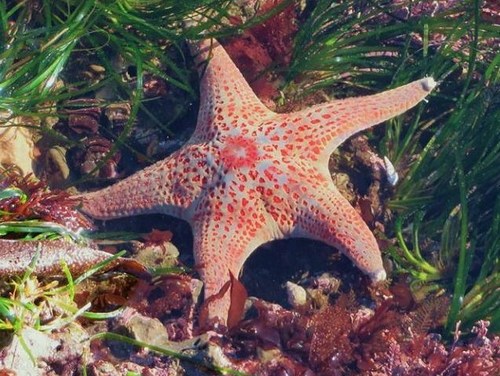
Sand Star
luidia foliolata
The Sand Star is a fascinating sea creature that looks like a star! It has many arms that help it move across the ocean floor.
Hábitat: Shallow coastal waters and sandy ocean floors.
The Sand Star is a very flat sea star, typically with five long, leaf-like arms. Its body is light tan to grey-green, often speckled, allowing it to blend perfectly with sandy seabeds.
Categoría
InvertebrateRareza
Common
Peligro
1/5 · Muy bajo
Snaps
¡Sé la primera persona en hacer un snap!
Sand Stars belong to a group called "echinoderms," meaning "spiny skin."
Some Sand Star species can move surprisingly fast for a sea star!
Their mouth is located on their underside, facing directly into the sand.
They move across the seabed using thousands of tiny, suction-cup-like tube feet!
Sand Stars can regrow lost arms because of their special regenerative cells, which helps them survive predator attacks.
Sand Stars can rapidly bury themselves just beneath the sand because of their pointed tube feet, which helps them hide from predators.
Sand Stars can push their stomach outside their body to digest prey externally, which helps them eat larger food items.
Tiny crustaceans and worms are a favorite meal for this sandy hunter.
Enhydra lutris
Otters can crush and eat sea stars.

Metacarcinus magister
Crabs prey on smaller or injured sea stars.
Nereis vexillosa
Actively consumes marine worms living in the sand.
Los animales solitarios viven solos durante la mayor parte de su vida y solo interactúan con otros para aparearse o cuidar de sus crías.
El camuflaje describe a los organismos que poseen colores o patrones que les permiten mezclarse con su entorno.
Colorido describe a organismos u objetos que exhiben una amplia variedad de colores brillantes y distintivos.
Este rasgo identifica a los organismos cuya dieta consiste total o principalmente en tejido animal.

Los hábitats marinos abarcan todos los entornos de agua salada de los océanos de la Tierra, sustentando una inmensa diversidad de vida acuática.
Peligro
1/5 · Muy bajo
Todavía no hay notas especiales de seguridad.
35 cm
0.2 kg
12 años
Tiny crustaceans and worms are a favorite meal for this sandy hunter.
Shallow coastal waters and sandy ocean floors.
Foraging
Acércate para separar los grupos y explorar dónde se ha fotografiado este objeto.
Los snaps recientes aparecerán aquí a medida que se añadan nuevas observaciones.