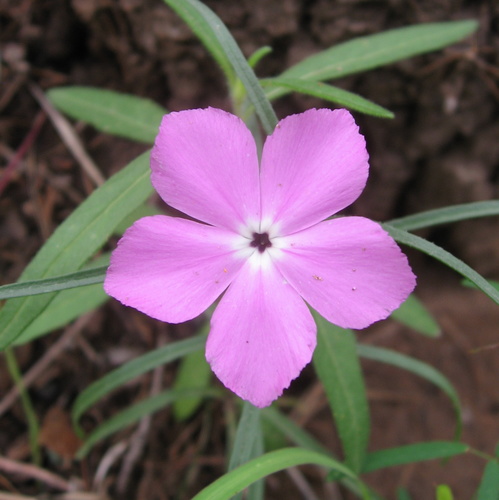


Santa Fe Phlox
phlox nana
The Santa Fe Phlox, scientifically known as Phlox nana, is a charming and resilient perennial herb native to the arid and semi-arid regions of the southwestern United States. This species is celebrated for its compact growth habit and prolific display of vibrant flowers, making it a standout in its often harsh environment. It plays a crucial role in its ecosystem by providing early-season nectar for various pollinators and contributing to soil stabilization in dry, rocky soils. Its ability to thrive in challenging conditions showcases nature's adaptability and beauty.
Hábitat: The Santa Fe Phlox is typically found in dry, rocky or sandy soils, often in open grasslands, pinyon-juniper woodlands, or desert scrub habitats.
The Santa Fe Phlox typically forms a low-growing, mat-like plant, usually reaching heights of 5 to 20 centimeters. Its narrow, linear leaves are often covered in fine hairs, giving them a somewhat gray-green appearance. The star attraction is its five-petaled, funnel-shaped flowers, which range in color from brilliant pink to lavender, sometimes appearing pure white, often with a distinct darker eye or stripe at the center. These blossoms typically measure 1.5 to 2.5 cm across and are clustered at the stem tips.
Categoría
PlantasRareza
Common
Peligro
1/5 · Muy bajo
Snaps
¡Sé la primera persona en hacer un snap!
Despite its delicate appearance, Phlox nana is incredibly tough, often thriving in extreme heat and dry conditions where many other plants struggle.
Its compact size and vibrant blooms make it a popular choice for native plant enthusiasts looking to create xeriscape gardens that conserve water.
The genus name 'Phlox' comes from the Greek word for 'flame,' likely referring to the intense, fiery colors of some phlox species.
This phlox possesses a well-developed taproot system that allows it to access deeper soil moisture, enabling survival in prolonged periods of drought common in its native habitat.
Its brightly colored, fragrant flowers act as a powerful visual and olfactory signal, attracting a diverse range of pollinators such as bees and butterflies essential for its reproduction.
The plant produces numerous small seeds that are efficiently dispersed by wind or small animals, allowing it to colonize new suitable areas quickly after favorable conditions.
As an autotrophic plant, the Santa Fe Phlox produces its own food through photosynthesis, converting sunlight, carbon dioxide, and water into sugars for energy and growth.
Apis mellifera
Primary pollinator, collecting nectar and pollen.
Vanessa cardui
Primary pollinator, collecting nectar and contributing to cross-pollination.
Odocoileus hemionus
Feeds on leaves and stems, potentially impacting plant health.
Aún no hay insignias de rasgos asignadas a este objeto.
Todavía no hay alias listados.
Las colecciones para este objeto aparecerán aquí a medida que se añadan más temas.
Peligro
1/5 · Muy bajo
Todavía no hay notas especiales de seguridad.
La forma más fácil de identificar a Santa Fe Phlox es usar la aplicación de identificación de naturaleza Snappit.
5-20 cm
2-5 años
As an autotrophic plant, the Santa Fe Phlox produces its own food through photosynthesis, converting sunlight, carbon dioxide, and water into sugars for energy and growth.
The Santa Fe Phlox is typically found in dry, rocky or sandy soils, often in open grasslands, pinyon-juniper woodlands, or desert scrub habitats.
Photosynthesis
Acércate para separar los grupos y explorar dónde se ha fotografiado este objeto.
Los snaps recientes aparecerán aquí a medida que se añadan nuevas observaciones.













_Phlox_paniculata_famous_light_purple_-_Les_Martels%2C_Giroussens_Tarn.jpg&width=800)


