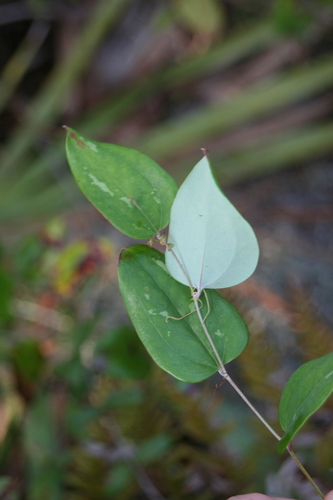


Sawbrier
smilax glauca
Sawbrier (Smilax glauca), also commonly known as glaucous greenbrier, is a highly resilient, woody vine native to the eastern and south-central United States. Known for its tough, climbing stems armed with sharp prickles, it easily scrambles over other vegetation to reach sunlight. What makes this plant particularly fascinating is its dual nature: while it can form dense, formidable thickets that deter hikers, it provides critical habitat and food for a wide variety of wildlife. Beneath its prickly exterior, Sawbrier plays an essential role in forest ecosystems. Its deep, tuberous root system allows it to survive wildfires and quickly regenerate, making it an important pioneer species in disturbed areas. Additionally, its evergreen to semi-evergreen leaves and dark blue-black berries offer year-round interest and valuable sustenance during the lean winter months.
Hábitat: Found in open woodlands, forest edges, fields, and disturbed areas, often thriving in sandy or acidic soils.
Sawbrier is distinguished by its green, woody vines covered in a whitish, waxy bloom (glaucous coating) and armed with stout, sharp prickles. Its leaves are alternate, ovate to broadly elliptic, often showing a striking pale, silvery-white underside due to this glaucous coating. In the spring, it produces small, inconspicuous clusters of greenish-yellow flowers, which give way to clusters of small, round, dark-blue or black berries covered with a powdery blue bloom in the fall.
Categoría
PlantasRareza
Common
Peligro
1/5 · Muy bajo
Snaps
¡Sé la primera persona en hacer un snap!
Native Americans used the starchy, tuberous roots of Smilax species to make a jelly-like food and a beverage similar to root beer.
The waxy, whitish coating on the leaves acts as a natural sunscreen, protecting the plant from ultraviolet radiation.
The young, tender shoots of Sawbrier can be harvested in spring, cooked like asparagus, or eaten raw in salads.
A waxy, whitish coating on the leaves and stems reduces water loss and reflects excess solar radiation.
Large, woody underground tubers store energy, enabling the plant to rapidly sprout back after intense forest fires.
Specialized paired stipular tendrils allow the vine to anchor itself securely to adjacent trees and shrubs to climb toward the canopy.
As a photosynthetic plant, Sawbrier synthesizes its own food using sunlight, carbon dioxide, and water absorbed through its roots.
Cardinalis cardinalis
The berries of Sawbrier are an important winter food source for songbirds.
Odocoileus virginianus
Browses on the leaves and tender young shoots, especially in the spring.
Sylvilagus floridanus
Eats the young stems and uses the dense, thorny thickets for nesting and predator shelter.
Aún no hay insignias de rasgos asignadas a este objeto.
Todavía no hay alias listados.
Las colecciones para este objeto aparecerán aquí a medida que se añadan más temas.
Peligro
1/5 · Muy bajo
Todavía no hay notas especiales de seguridad.
La forma más fácil de identificar a Sawbrier es usar la aplicación de identificación de naturaleza Snappit.
100-1000 cm
5-50 años
As a photosynthetic plant, Sawbrier synthesizes its own food using sunlight, carbon dioxide, and water absorbed through its roots.
Found in open woodlands, forest edges, fields, and disturbed areas, often thriving in sandy or acidic soils.
Acércate para separar los grupos y explorar dónde se ha fotografiado este objeto.
Los snaps recientes aparecerán aquí a medida que se añadan nuevas observaciones.

Connecticut, US
Puedes ver Quimáfila Rayada, Pírola Americana y Cincoenrama Enana.
Ver guía →

Connecticut, US
Puedes ver Quimáfila Rayada, Pírola Americana y Cincoenrama Enana.
Ver guía →