

Schott'S Pygmycedar
peucephyllum schottii
Schott's Pygmycedar (Peucephyllum schottii) is a fascinating desert-dwelling shrub native to the arid landscapes of the southwestern United States and northwestern Mexico. Despite its convincing conifer-like appearance, which inspires its common name, it is actually a member of the sunflower family (Asteraceae). This highly specialized evergreen shrub thrives in some of the harshest environments imaginable, clinging to rocky canyon walls and dry gravelly washes. The plant plays a crucial role in its desert ecosystem, providing nesting structure for small desert fauna and offering nectar to early-season pollinators. Its ability to remain vibrant green and actively grow during the searing summer heat makes it a remarkable example of desert adaptation.
Hábitat: Found in dry, rocky desert canyons, gravelly washes, and steep cliffs of the Mojave, Sonoran, and Colorado deserts.
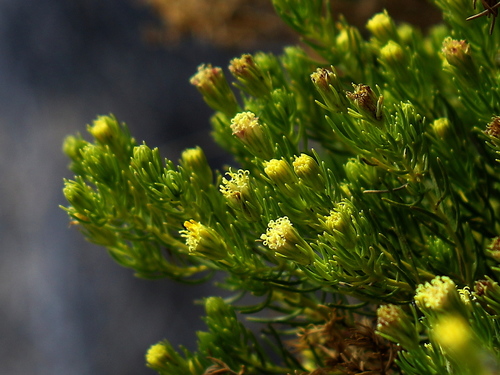
Schott's Pygmycedar forms a dense, rounded, and highly branched shrub reaching heights of 100 to 300 centimeters. Its most striking feature is its foliage: crowded, needle-like leaves that are bright yellow-green, highly resinous, and measuring about 1 to 2 centimeters long. In late winter and spring, the tips of its branches erupt with small, solitary, bell-shaped flower heads. These flower heads lack showy outer ray florets and consist entirely of yellow disc florets surrounded by green bracts, giving them a distinct button-like appearance.
Categoría
PlantasRareza
Common
Peligro
1/5 · Muy bajo
Snaps
¡Sé la primera persona en hacer un snap!
Despite its common name 'Pygmycedar' and needle-like leaves, it is a true member of the sunflower family (Asteraceae) and is not closely related to conifers.
Its foliage is so resinous that Native Americans historically used the sticky leaves and twigs for medicinal purposes and as a natural adhesive.
The genus name 'Peucephyllum' literally translates to 'pine-leaf', referencing its striking visual similarity to pine needles.
The leaves are coated in a thick, sticky resin that drastically reduces water loss from evaporation and deters herbivores.
It mimics the needle-like morphology of conifers to minimize surface area exposed to intense desert sunlight while maintaining year-round photosynthesis.
A deep and highly tenacious root system allows it to anchor firmly in vertical rocky cliff faces and extract moisture from deep bedrock fractures.
As a photoautotrophic plant, Schott's Pygmycedar synthesizes its own organic compounds from sunlight, carbon dioxide, and water through photosynthesis.
Ovis canadensis nelsoni
Desert bighorn sheep occasionally browse on the tough, resinous foliage of the shrub during periods of extreme forage scarcity.
Halictus tripartitus
This native bee visits the yellow disc flowers of Schott's Pygmycedar to collect nectar and pollen, aiding in the shrub's pollination.
Aún no hay insignias de rasgos asignadas a este objeto.
Todavía no hay alias listados.
Las colecciones para este objeto aparecerán aquí a medida que se añadan más temas.
Peligro
1/5 · Muy bajo
Todavía no hay notas especiales de seguridad.
La forma más fácil de identificar a Schott'S Pygmycedar es usar la aplicación de identificación de naturaleza Snappit.
100-300 cm
10-50 años
As a photoautotrophic plant, Schott's Pygmycedar synthesizes its own organic compounds from sunlight, carbon dioxide, and water through photosynthesis.
Found in dry, rocky desert canyons, gravelly washes, and steep cliffs of the Mojave, Sonoran, and Colorado deserts.
Acércate para separar los grupos y explorar dónde se ha fotografiado este objeto.
Los snaps recientes aparecerán aquí a medida que se añadan nuevas observaciones.