

Sea Squill Complex
drimia maritima
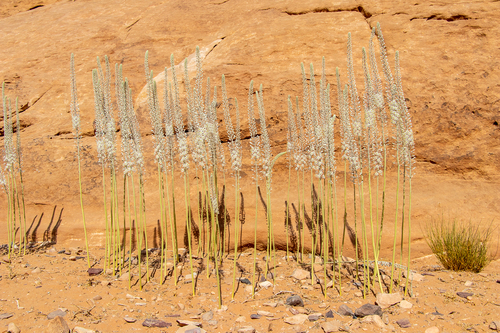
The Sea Squill Complex (Drimia maritima) is a striking and resilient perennial plant native to the Mediterranean basin. Famed for its massive, partially exposed bulb—which can grow to the size of a small football—this remarkable plant is a master of survival in harsh, dry environments. It follows a unique life cycle known as hysteranthy, meaning it sends up a towering, dramatic spike of starry white flowers in late summer or autumn, long before its lush, broad leaves emerge in the winter. Beyond its dramatic appearance, the Sea Squill has a rich history intertwined with human civilization. Packed with potent cardiac glycosides, the plant is highly toxic to most herbivores. This powerful chemical defense historically made it a popular natural rodenticide and a carefully measured medicinal herb in ancient Greece and Egypt. Today, its towering floral spikes stand as iconic heralds of autumn across rocky coastal shrublands.
Hábitat: Found primarily in Mediterranean coastal regions, it thrives in rocky, sandy soils within dry, open habitats such as garrigue, maquis, and coastal steppes.
The Sea Squill is easily recognized by its enormous, scaly bulb that often protrudes prominently above the soil surface, covered in a papery tunic that ranges from reddish-brown to pale green. In late summer, a leafless, sturdy floral stem erupts from the bulb, reaching up to nearly 2 meters (6.5 feet) in height. This towering spike is densely packed with dozens of small, six-petaled white flowers featuring distinct greenish-purple central stripes and yellow stamens. During the winter and spring, the plant produces a dense basal rosette of large, leathery, dark green lanceolate leaves with a waxy coating, which wither and die back completely before the intense heat of summer.
Categoría
PlantasRareza
Common
Peligro
1/5 · Muy bajo
Snaps
¡Sé la primera persona en hacer un snap!
Ancient Greeks and Romans planted Sea Squill near the entrances of their homes, believing the giant bulbs would ward off evil spirits.
Before the invention of modern synthetic rodenticides, a red-bulbed variety of this plant was dried and crushed to make 'red squill,' a widely used and highly effective rat poison.
In the Mediterranean, the sudden appearance of the Sea Squill's towering flower spikes is traditionally considered the first natural sign that autumn is approaching.
The bulb of the Sea Squill can grow to an astonishing diameter of up to 30 centimeters (12 inches) and can weigh well over 3 kilograms (6.5 lbs).
The plant blooms in late summer to autumn before its leaves appear, completely separating its reproductive and vegetative stages to avoid severe summer heat.
It stores massive amounts of water and nutrients in its oversized bulb, allowing it to survive prolonged Mediterranean summer droughts.
Produces highly toxic cardiac glycosides, such as scillaren A, which deter grazing mammals and protect the bulb from consumption.
As a photosynthetic plant, the Sea Squill generates its own energy using sunlight, carbon dioxide, and water.
Apis mellifera
Visits the nectar-rich flowers in late summer, providing crucial pollination services when few other plants are blooming.
Vespa orientalis
Frequently attracted to the tall, prominent flower spikes to feed on nectar, acting as a secondary pollinator.
Aún no hay insignias de rasgos asignadas a este objeto.
Todavía no hay alias listados.
Las colecciones para este objeto aparecerán aquí a medida que se añadan más temas.
Peligro
1/5 · Muy bajo
Todavía no hay notas especiales de seguridad.
La forma más fácil de identificar a Sea Squill Complex es usar la aplicación de identificación de naturaleza Snappit.
50-200 cm
0.5-3.5 kg
15-50 años
As a photosynthetic plant, the Sea Squill generates its own energy using sunlight, carbon dioxide, and water.
Found primarily in Mediterranean coastal regions, it thrives in rocky, sandy soils within dry, open habitats such as garrigue, maquis, and coastal steppes.
Photosynthesis
Acércate para separar los grupos y explorar dónde se ha fotografiado este objeto.
Los snaps recientes aparecerán aquí a medida que se añadan nuevas observaciones.




.jpg&width=800)



