

Seacliff Wild Buckwheat
eriogonum parvifolium
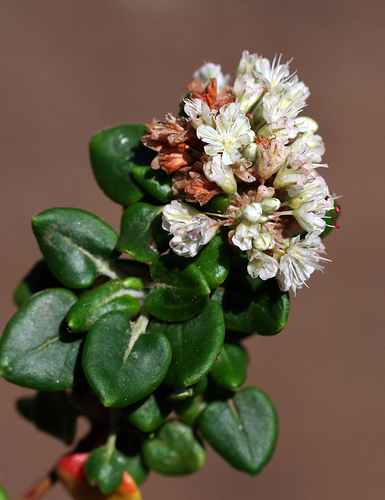
Seacliff Wild Buckwheat (Eriogonum parvifolium) is a resilient, evergreen shrub native to the coastal bluffs and dunes of California. Clinging to windswept cliffs, this tough plant plays a critical role in stabilizing fragile coastal soils against erosion. It forms dense, low-growing mounds decorated with clusters of delicate, pom-pom-like flowers that transition from creamy white to pinkish-bronze as they mature. More than just a hardy survivor, Seacliff Wild Buckwheat is a keystone species within its native ecosystem. It serves as the primary lifesaver for several rare insect species, most notably the endangered El Segundo blue butterfly, which relies entirely on this plant for food and shelter throughout its life cycle. Gardeners and nature enthusiasts cherish it for its drought tolerance and outstanding ecological value in coastal conservation.
Hábitat: Found clinging to sandy coastal bluffs, coastal sage scrub, and active or stabilized dunes along the California coastline.
This low, spreading shrub typically grows up to 100 cm in height and can sprawl even wider. It features small, thick, leathery leaves that are dark green on top with distinctive rolled-under margins, and covered in a dense, woolly white fuzz underneath to reduce water loss. The flowers are arranged in dense, rounded, head-like clusters at the tips of branching stems; these blossoms are small and bell-shaped, starting out white to light pink in late spring and drying to a rich rust or copper-brown by autumn.
Categoría
PlantasRareza
Common
Peligro
1/5 · Muy bajo
Snaps
¡Sé la primera persona en hacer un snap!
Its scientific name 'parvifolium' translates to 'small-leaved', referencing the tiny, drought-resistant leaves that help it survive extreme coastal conditions.
The El Segundo blue butterfly is entirely dependent on this single plant species to complete its entire life cycle, from egg to caterpillar to adult.
The rusty-brown dried flower heads can persist on the plant for months, giving it a dual-toned appearance during the late summer and fall.
Developed thick, leathery leaves with rolled edges and a waxy coating to withstand salty sea breezes and heavy coastal winds.
Employs deep, extensive taproots and fibrous lateral roots to anchor in shifting sands and access moisture deep below.
The undersides of the leaves are covered in dense, white, felt-like hairs that trap ambient humidity and reduce transpiration.
As a photoautotroph, this plant synthesizes its own food using sunlight, water, and carbon dioxide through photosynthesis, drawing essential minerals from sandy coastal soils.
Euphilotes allyni
Provides the exclusive larval food source and adult nectar source for this federally endangered butterfly.
Euphilotes enoptes smithi
Acts as a primary host plant and nectar source for this threatened coastal butterfly.
Apis mellifera
Attracts honey bees and other native bees for pollination in exchange for nectar.
Aún no hay insignias de rasgos asignadas a este objeto.
Todavía no hay alias listados.
Las colecciones para este objeto aparecerán aquí a medida que se añadan más temas.
Peligro
1/5 · Muy bajo
Todavía no hay notas especiales de seguridad.
La forma más fácil de identificar a Seacliff Wild Buckwheat es usar la aplicación de identificación de naturaleza Snappit.
30-100 cm
0.5-4 kg
5-20 años
As a photoautotroph, this plant synthesizes its own food using sunlight, water, and carbon dioxide through photosynthesis, drawing essential minerals from sandy coastal soils.
Found clinging to sandy coastal bluffs, coastal sage scrub, and active or stabilized dunes along the California coastline.
Acércate para separar los grupos y explorar dónde se ha fotografiado este objeto.
Los snaps recientes aparecerán aquí a medida que se añadan nuevas observaciones.
















