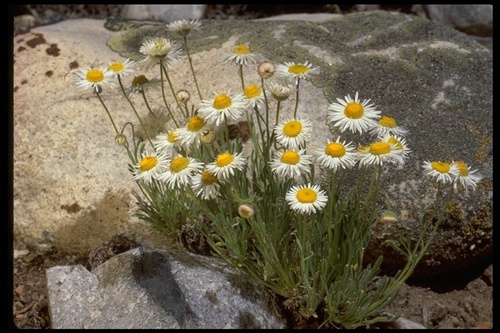


Shaggy Fleabane
erigeron pumilus
Shaggy Fleabane (Erigeron pumilus) is a charming and resilient perennial wildflower native to the vast dry regions of western North America. Thriving in sagebrush plains, rocky slopes, and open grasslands, this tough little plant is well-adapted to survive arid environments. Its most distinctive feature is its dense covering of stiff, spreading white hairs, which give the entire plant a rough, 'shaggy' appearance. This hairiness is not just for show; it serves as a critical defense against water loss and harsh solar radiation. In late spring and early summer, Shaggy Fleabane produces a cheerful display of daisy-like flower heads. Each flower head consists of numerous narrow, white to pale lavender-pink ray florets surrounding a bright yellow central disc. As a key component of its native ecosystem, it provides valuable sustenance to diverse pollinators, including native bees, butterflies, and beetles.
Hábitat: Found in dry, open plains, sagebrush steppes, and rocky foothill slopes, typically in sandy or gravelly soils.
This low-growing perennial stands between 5 and 30 centimeters tall, forming neat tufts of stems. The entire plant, including the stems, narrow alternate leaves, and flower bracts, is densely covered in prominent, spreading white hairs. Its daisy-like flower heads, measuring about 1.5 to 2.5 centimeters across, feature 50 to 100 thin, linear ray petals that are typically bright white, though they can occasionally range to pale pink or lavender. These ray petals surround a prominent, flat center of golden-yellow disc florets.
Categoría
PlantasRareza
Common
Peligro
1/5 · Muy bajo
Snaps
¡Sé la primera persona en hacer un snap!
Erigeron pumilus is exceptionally hairy, a physical defense mechanism that helps it retain moisture and deter herbivores in arid climates.
Indigenous peoples historically used various fleabane species for traditional medicinal remedies, including treating colds and headaches.
The name 'fleabane' comes from an old belief that dried plants could repel or kill fleas.
The dense coating of stiff, white hairs creates a boundary layer of air, dramatically reducing transpiration and protecting the plant from drying winds.
The pale, hairy surface reflects excess ultraviolet radiation, preventing sunburn and heat damage in exposed, high-altitude environments.
A deep, sturdy taproot system allows the plant to access moisture deep within parched soils and remain securely anchored in shifting gravel.
As a photoautotrophic plant, it manufactures its own organic nutrients from sunlight, carbon dioxide, and water through the process of photosynthesis.
Bombus occidentalis
Bees visit the flowers to collect nectar and pollen, acting as primary pollinators.
Antilocapra americana
The foliage is occasionally grazed by native western mammals as part of their mixed herbivorous diet.
Chlosyne acastus
Provides nectar for various native butterflies and serves as a potential host plant.
Aún no hay insignias de rasgos asignadas a este objeto.
Todavía no hay alias listados.
Las colecciones para este objeto aparecerán aquí a medida que se añadan más temas.
Peligro
1/5 · Muy bajo
Todavía no hay notas especiales de seguridad.
La forma más fácil de identificar a Shaggy Fleabane es usar la aplicación de identificación de naturaleza Snappit.
5-30 cm
2-10 años
As a photoautotrophic plant, it manufactures its own organic nutrients from sunlight, carbon dioxide, and water through the process of photosynthesis.
Found in dry, open plains, sagebrush steppes, and rocky foothill slopes, typically in sandy or gravelly soils.
Acércate para separar los grupos y explorar dónde se ha fotografiado este objeto.
Los snaps recientes aparecerán aquí a medida que se añadan nuevas observaciones.

















.jpg&width=800)

