

Silver Shiner
notropis photogenis
The Silver Shiner (Notropis photogenis) is a sleek, silvery minnow native to clear, flowing waters across eastern and central North America. Known for its brilliant, reflective scales, this small fish is a common sight in rivers and large streams, where it forms schools that gleam like living jewels in the sunlight. Its name, 'photogenis,' literally means 'light-born,' a fitting tribute to its striking appearance. Silver Shiners play a crucial role in their aquatic ecosystems, serving as both predators of small invertebrates and a vital food source for larger fish and piscivorous birds, highlighting their importance in the food web.
Hábitat: The Silver Shiner thrives in clear, cool to warm, moderately flowing waters of medium to large rivers and streams, often over gravel, rubble, or bedrock substrates, and occasionally in lakes.
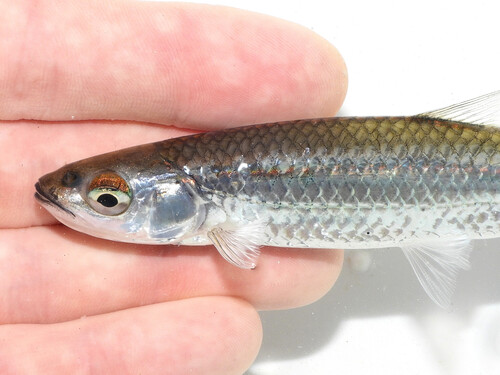
The Silver Shiner is characterized by its slender, elongated body, reaching lengths of 9-15 cm. Its most prominent feature is its intensely silvery coloration, particularly on its sides, which are highly reflective and can appear almost mirror-like in clear water. The dorsal side is typically olive-green to greenish-silver, fading to bright silver below. It possesses a distinct, often dark, lateral stripe that may fade with age, and large, prominent eyes. The fins are generally clear to slightly yellowish, with the dorsal fin positioned above the pelvic fins.
Categoría
PecesRareza
Common
Peligro
1/5 · Muy bajo
Snaps
¡Sé la primera persona en hacer un snap!
Despite their small size, Silver Shiners are quite active and can navigate strong currents with impressive agility.
Silver Shiners are often used as bait fish by anglers due to their abundance and appealing flash.
The scientific name 'photogenis' is derived from Greek words meaning 'light-born' or 'shining,' perfectly describing its silvery appearance.
They are considered an indicator species for water quality; their presence often signifies relatively clean, unpolluted aquatic environments.
The Silver Shiner's highly reflective scales create a shimmering effect that makes it difficult for predators to pinpoint them, especially in sunlit, flowing water. This visual confusion aids in evasion and reduces individual predation risk.
Its sleek, torpedo-shaped body and powerful caudal fin are perfectly adapted for life in currents. This allows the Silver Shiner to maintain position and move efficiently in fast-flowing river environments.
Silver Shiners aggregate in large, cohesive schools, a behavior that provides increased protection against predators. The 'many eyes' effect helps detect threats, and coordinated movements can confuse attackers.
Silver Shiners are opportunistic omnivores, primarily feeding on aquatic insect larvae and small crustaceans, but also consuming terrestrial insects that fall into the water, as well as some plant material like diatoms and filamentous algae.
Diferencias por edad: Younger shiners consume smaller invertebrates and plant matter, gradually shifting to a wider array of aquatic insects and crustaceans as they grow larger.
Micropterus salmoides
A common predator that ambushes Silver Shiners.
Ardea herodias
A wading bird that frequently preys on small fish like the Silver Shiner.
Ephemeroptera species
Larvae of this insect are a primary food source for Silver Shiners.
Trichoptera species
Larvae of this insect group are a significant part of the Silver Shiner's diet.
Aún no hay insignias de rasgos asignadas a este objeto.
Todavía no hay alias listados.
Las colecciones para este objeto aparecerán aquí a medida que se añadan más temas.
Peligro
1/5 · Muy bajo
Todavía no hay notas especiales de seguridad.
La forma más fácil de identificar a Silver Shiner es usar la aplicación de identificación de naturaleza Snappit.
9-15 cm
0.01-0.03 kg
3-5 años
15 km/h
Silver Shiners are opportunistic omnivores, primarily feeding on aquatic insect larvae and small crustaceans, but also consuming terrestrial insects that fall into the water, as well as some plant material like diatoms and filamentous algae.
The Silver Shiner thrives in clear, cool to warm, moderately flowing waters of medium to large rivers and streams, often over gravel, rubble, or bedrock substrates, and occasionally in lakes.
Foraging
Acércate para separar los grupos y explorar dónde se ha fotografiado este objeto.
Los snaps recientes aparecerán aquí a medida que se añadan nuevas observaciones.













