






Slender Bluet
Enallagma traviatum
The Slender Bluet is a small, beautiful dragonfly with bright blue colors. They love to flutter around ponds and streams, making them fun to watch as they zoom by!
Hábitat: Wetlands
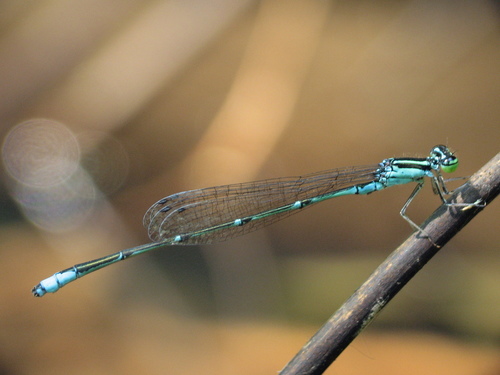
The Slender Bluet is a small damselfly with a very slender body. Males are strikingly bright blue with distinct black markings, including a black "wine-glass" or "keyhole" shape on the second abdominal segment. Females are typically duller, appearing greenish or brownish.
Categoría
InsectosRareza
Common
Peligro
1/5 · Muy bajo
Snaps
¡Sé la primera persona en hacer un snap!
Adult Slender Bluets often eat hundreds of mosquitoes and other small flying pests daily!
Most of a Slender Bluet's life is spent underwater as a fascinating aquatic nymph!
Their wings can move separately, allowing them to hover or make super-fast turns in the air!
You can tell male Slender Bluets apart by a unique black "wine glass" pattern on their abdomen!
Slender Bluets have huge compound eyes that help them spot tiny prey and predators from almost every direction.
The Slender Bluet can launch into flight instantly from a perch to chase after prey or quickly escape from danger.
Slender Bluets have tiny claws on their legs that help them cling tightly to plants, even upside down, near water.
They are tiny hunters, catching and eating small flying insects or aquatic larvae in the water.
Diferencias por edad: Nymphs eat aquatic insects; adults hunt flying insects.
Culex pipiens
Adults and nymphs prey on mosquitoes.
Lithobates clamitans
Frogs prey on both adult and nymph damselflies.
Anax junius
Larger dragonflies often hunt damselflies.
Typha latifolia
Provides perching sites and habitat for nymphs.
Los animales solitarios viven solos durante la mayor parte de su vida y solo interactúan con otros para aparearse o cuidar de sus crías.
Las criaturas aéreas pasan una parte importante de su vida en el aire, utilizando el vuelo para diversas actividades como la caza, la migración o la anidación.
Colorido describe a organismos u objetos que exhiben una amplia variedad de colores brillantes y distintivos.
Este rasgo identifica a los organismos cuya dieta consiste principalmente en insectos y otros pequeños invertebrados.

Este rasgo de hábitat identifica especies que se encuentran en humedales, que son áreas de tierra saturadas de agua, ya sea permanente o estacionalmente, e incluyen marismas, pantanos y ciénagas.

Los hábitats de agua dulce incluyen entornos acuáticos no salinos como ríos, lagos, estanques y humedales, vitales para numerosas especies.

Los animales diurnos están activos principalmente durante el día y suelen descansar o dormir por la noche.

Este rasgo identifica a los organismos que exhiben una rapidez excepcional en sus movimientos para cazar, escapar o desplazarse.

Describe organismos que transfieren polen, permitiendo la fertilización y reproducción de las plantas.
Todavía no hay alias listados.
Peligro
1/5 · Muy bajo
Dragonflies are harmless and fun to watch, but don't try to catch them!
35-45 mm
28-35 mm
30-50 días
15 km/h
They are tiny hunters, catching and eating small flying insects or aquatic larvae in the water.
Wetlands
Pursuit
6
Acércate para separar los grupos y explorar dónde se ha fotografiado este objeto.
Los snaps recientes aparecerán aquí a medida que se añadan nuevas observaciones.








.jpg&width=800)



.jpg&width=800)