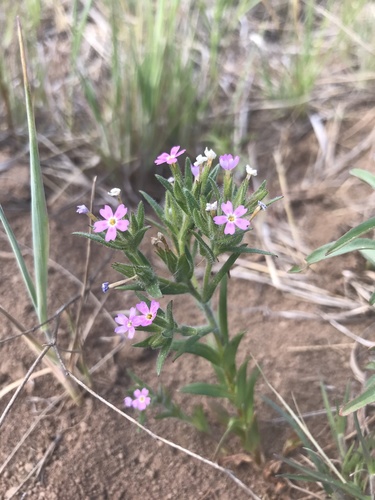


Slender Phlox
microsteris gracilis
The Slender Phlox is an unassuming yet delightful annual wildflower native to western North America. Growing low to the ground, this hardy pioneer species is one of the first to splash color across grassy slopes, open woodlands, and sagebrush flats during the early spring. Its minute pink and white blossoms play a crucial role in supporting early-emerging insect pollinators, providing them with vital nectar when other food sources are scarce. Despite its delicate appearance, Slender Phlox is incredibly resilient, thriving in disturbed soils and dry conditions where other plants struggle. Its rapid life cycle allows it to germinate, bloom, and set seed before the scorching heat of summer arrives, making it a master of drought avoidance.
Hábitat: Typically found in open, vernally moist to dry grassy areas, meadows, sagebrush scrublands, and open foothill woodlands.
Slender Phlox is a tiny herbaceous plant typically standing between 2 and 20 centimeters tall. It features a slender, branching stem covered in sticky, glandular hairs that can catch small debris. The leaves are narrow, lance-shaped, and arranged oppositely along the lower stem, transitioning to an alternate pattern near the top. Its flowers are exceptionally small, measuring only 5 to 10 millimeters across, with five flat lobes that range in color from soft pink to lavender or white, usually surrounding a contrasting yellow or white throat.
Categoría
PlantasRareza
Common
Peligro
1/5 · Muy bajo
Snaps
¡Sé la primera persona en hacer un snap!
Despite its common name 'Slender Phlox', it was historically placed in its own distinct genus, Microsteris, due to its unique flower structure.
Its species name 'gracilis' translates to 'slender' or 'graceful' in Latin, reflecting its delicate growth form.
The sticky hairs on its stem can trap small gnats, though the plant is not carnivorous and does not digest them.
Completes its entire life cycle from seed to seed in early spring to completely avoid summer heat and drought.
Stems are coated in sticky, glandular hairs that deter small crawling herbivores and insect pests.
Produces seeds that become sticky when wet, allowing them to adhere to animal fur for efficient dispersal.
As a photoautotroph, the Slender Phlox produces its own energy via photosynthesis, utilizing sunlight, water, carbon dioxide, and soil minerals.
Bombylius major
Pollinated by small nectar-seeking flies in spring.
Odocoileus hemionus
Foraged upon by grazing native ungulates during early spring growth.
Glomus intraradices
Symbiotic soil fungi that assist the plant with nutrient absorption.
Aún no hay insignias de rasgos asignadas a este objeto.
Todavía no hay alias listados.
Las colecciones para este objeto aparecerán aquí a medida que se añadan más temas.
Peligro
1/5 · Muy bajo
Todavía no hay notas especiales de seguridad.
La forma más fácil de identificar a Slender Phlox es usar la aplicación de identificación de naturaleza Snappit.
2+ cm
0.001+ kg
0+ años
As a photoautotroph, the Slender Phlox produces its own energy via photosynthesis, utilizing sunlight, water, carbon dioxide, and soil minerals.
Typically found in open, vernally moist to dry grassy areas, meadows, sagebrush scrublands, and open foothill woodlands.
Photosynthesis
5+
Acércate para separar los grupos y explorar dónde se ha fotografiado este objeto.
Los snaps recientes aparecerán aquí a medida que se añadan nuevas observaciones.