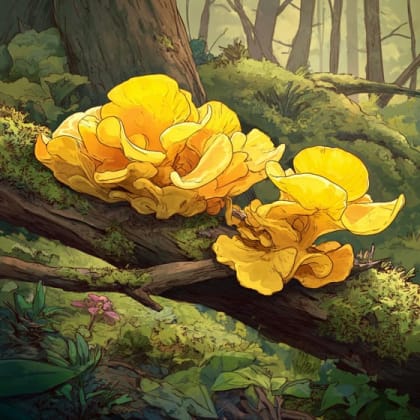
Slime Molds
mycetozoa
Slime molds are fascinating creatures that can change shape and color! They often look like colorful blobs crawling on rotting wood or leaves.
Hábitat: Slime molds are commonly found in damp, shady areas like forests and gardens.
The Slime Molds are often brightly colored, appearing as yellow, orange, or red gooey blobs called plasmodia that creep across surfaces. They can also form intricate, tiny, stalked structures of varying colors like white, brown, or black when reproducing. Their unique amoeboid movement makes them visually distinct.
Categoría
HongosRareza
Common
Peligro
0/5 · Sin peligro conocido
Snaps
¡Sé la primera persona en hacer un snap!
Scientists use slime molds to design efficient road networks and even study city planning!
Slime molds are not fungi; they are fascinating single-celled organisms that act like animals!
These amazing blobs can grow to cover areas over a square meter, exploring huge spaces!
Without a brain, slime molds can learn and even share what they've learned with others!
Slime molds can solve mazes by growing along the shortest path, which helps them find food efficiently.
Slime molds can remember chemical cues, which helps them avoid harmful substances and find new food sources.
Slime molds can quickly re-fuse if separated, which helps them repair damage and grow larger networks.
Slime molds can move as one large, single-celled organism, which helps them explore vast areas for food.
Feeds on bacteria, spores, and other microscopic organisms by engulfing them.
Escherichia coli
Engulfs bacterial colonies for nutrients.
Folsomia candida
Small invertebrates graze on slime mold structures.
Quercus rubra
Thrives on decaying wood and leaf litter from this tree.
Los animales solitarios viven solos durante la mayor parte de su vida y solo interactúan con otros para aparearse o cuidar de sus crías.
Colorido describe a organismos u objetos que exhiben una amplia variedad de colores brillantes y distintivos.
Los hábitats boscosos son entornos terrestres dominados por una densa cubierta arbórea, que sustentan una gran diversidad de vida animal y vegetal.
Describe a los organismos que descomponen la materia orgánica muerta, reciclando los nutrientes de vuelta al ecosistema.

Los hábitats acuáticos abarcan entornos donde los organismos viven principalmente en el agua, incluidos océanos, ríos, lagos y humedales.
Peligro
0/5 · Sin peligro conocido
Todavía no hay notas especiales de seguridad.
0.1-10 cm
inedible
Feeds on bacteria, spores, and other microscopic organisms by engulfing them.
Slime molds are commonly found in damp, shady areas like forests and gardens.
wood
Todo el año
Various (white, brown, black, purple)
Acércate para separar los grupos y explorar dónde se ha fotografiado este objeto.
Los snaps recientes aparecerán aquí a medida que se añadan nuevas observaciones.






_and_beneficial_bacteria_on_plant_performance_and_soil_fertility.webp&width=800)