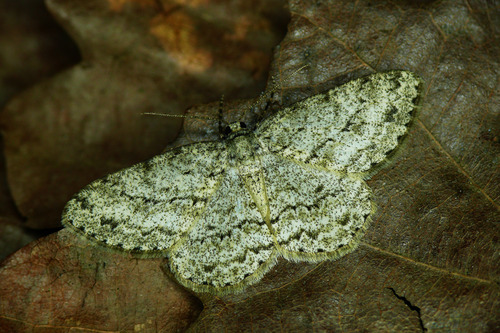


Small Engrailed
ectropis crepuscularia
The Small Engrailed (Ectropis crepuscularia) is a master of disguise within the moth world. Belonging to the family Geometridae, this nocturnal insect blends seamlessly against the lichen-covered bark of various trees during the day. Its intricate, wavy wing patterns resemble the fine lines engraved in wood, giving it its distinctive name. Highly adaptable, it thrives in a wide range of wooded habitats across the Northern Hemisphere. This moth is a fascinating subject for nature enthusiasts who enjoy a good game of hide-and-seek. Its caterpillars, known as loopers or inchworms, move with a charming looping motion and feed on a diverse menu of trees and shrubs. Observing the Small Engrailed offers a wonderful glimpse into the marvels of evolutionary camouflage and the delicate balance of forest ecosystems.
Hábitat: Found in a variety of wooded environments, including deciduous and coniferous forests, parks, gardens, and shrubby hedgerows.
The Small Engrailed features a wingspan of 3 to 5 centimeters. Its wings are characterized by a highly variable pale grey to light brown ground color, intricately dusted and patterned with dark brown or blackish wavy lines, bands, and speckles. A distinct dark, wavy line runs across both the forewings and hindwings. When resting, it flattens its wings completely against tree trunks, perfectly matching the texture of bark and lichens. This resting posture, combined with its mottled coloration, makes it nearly invisible to the untrained eye.
Categoría
InsectosRareza
Common
Peligro
1/5 · Muy bajo
Snaps
¡Sé la primera persona en hacer un snap!
Despite their name, adult Small Engrailed moths do not 'engrave' anything; their name comes from the fine, wood-engraving-like patterns on their wings.
In some regions, this moth produces two generations in a single year (double-brooded), with the second generation often being smaller and darker.
This species is highly sensitive to light pollution, which can disrupt their nocturnal mating and feeding behaviors.
Its bark-like wing coloration and flat resting posture allow it to completely blend into tree trunks, avoiding detection by visual predators.
As caterpillars, they lack middle prolegs, forcing them to draw their rear up to their front legs, forming a loop to move efficiently.
When threatened, the caterpillars can freeze and stiffen their bodies at an angle from a branch, perfectly mimicking a small twig.
The larvae feed on the leaves of a wide variety of deciduous and coniferous trees, while adults occasionally feed on nectar and tree sap.
Betula pendula
The caterpillars feed on the leaves of the silver birch, using it as a major developmental host plant.
Cyanistes caeruleus
Blue tits regularly hunt both the caterpillars and adult moths to feed themselves and their chicks.
Quercus robur
Larvae frequently feed on the foliage of mature oak trees during spring and summer.
Aún no hay insignias de rasgos asignadas a este objeto.
Todavía no hay alias listados.
Las colecciones para este objeto aparecerán aquí a medida que se añadan más temas.
Peligro
1/5 · Muy bajo
Todavía no hay notas especiales de seguridad.
La forma más fácil de identificar a Small Engrailed es usar la aplicación de identificación de naturaleza Snappit.
1+ cm
3+ cm
0+ kg
15 km/h
The larvae feed on the leaves of a wide variety of deciduous and coniferous trees, while adults occasionally feed on nectar and tree sap.
Found in a variety of wooded environments, including deciduous and coniferous forests, parks, gardens, and shrubby hedgerows.
Grazingindexedbylarvaespreadingonfoliage (foraging/grazing For Plant Tissue As Larvae, Nectar Feeding As Adults)
Acércate para separar los grupos y explorar dónde se ha fotografiado este objeto.
Los snaps recientes aparecerán aquí a medida que se añadan nuevas observaciones.








_male_Pt.jpg&width=800)


_gusano_cogollero.png&width=800)
