

Small-Eyed Sphinx
paonias myops
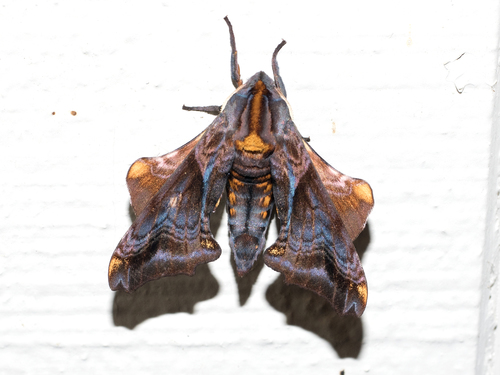
The Small-Eyed Sphinx (Paonias myops) is a fascinating member of the hawkmoth family, Sphingidae, native to North America. Known for its remarkable cryptic camouflage, this moth spends its resting hours mimicking a dead leaf to avoid detection by predators. It belongs to a group of moths where the adults possess reduced mouthparts and do not feed, relying entirely on the energy reserves they accumulated as caterpillars. This makes their adult life brief but highly focused on reproduction.
Hábitat: Found in deciduous woodlands, forest edges, suburban gardens, and orchards where host plants from the rose family are abundant.
This medium-sized moth features scalloped forewings colored in rich shades of chocolate brown, purplish-gray, and yellow-brown. When resting, it folds these wings to look like a dry leaf. However, when threatened, it parts them to reveal vibrant yellow hindwings marked with a striking, blue-centered black eyespot (ocellus) near the lower margin. It has a wingspan ranging from 4.5 to 7.5 centimeters, and its thorax has a distinct dark, velvety central stripe.
Categoría
InsectosRareza
Common
Peligro
1/5 · Muy bajo
Snaps
¡Sé la primera persona en hacer un snap!
Because adult Small-Eyed Sphinx moths cannot eat, their entire adult life lasts only about a week, dedicated solely to finding a mate.
The caterpillars have a small, lime-green horn on their rear end, a signature trait of the hawkmoth family commonly called hornworms.
Their scientific name 'myops' comes from Greek, meaning 'near-sighted' or 'closed-eyes', referring to the small size of their hindwing eyespots compared to related species.
Flashes its hidden, bright yellow hindwings and realistic blue-and-black eyespots to frighten potential predators like birds.
Mimics the shape, color, and texture of a dead, dry leaf when resting with its wings folded.
Survives entirely without feeding as an adult, efficiently utilizing lipids stored during its highly voracious caterpillar stage.
The larvae feed extensively on the leaves of deciduous trees and shrubs, particularly cherries and plums, while the adult moths do not feed at all.
Diferencias por edad: Larvae consume large quantities of foliage to store energy, whereas adults have non-functional mouthparts and do not consume food.
Prunus serotina
The larvae rely on this tree as their primary food source, feeding heavily on its foliage.
Cyanocitta cristata
Active songbirds opportunistically hunt both the adult moths and their large caterpillars.
Cotesia congregata
A parasitoid wasp that lays its eggs inside the living caterpillar, eventually killing the host.
Aún no hay insignias de rasgos asignadas a este objeto.
Todavía no hay alias listados.
Las colecciones para este objeto aparecerán aquí a medida que se añadan más temas.
Peligro
1/5 · Muy bajo
Todavía no hay notas especiales de seguridad.
La forma más fácil de identificar a Small-Eyed Sphinx es usar la aplicación de identificación de naturaleza Snappit.
2-4 cm
4-8 cm
0.0005-0.002 kg
1 años
18 km/h
The larvae feed extensively on the leaves of deciduous trees and shrubs, particularly cherries and plums, while the adult moths do not feed at all.
Found in deciduous woodlands, forest edges, suburban gardens, and orchards where host plants from the rose family are abundant.
Acércate para separar los grupos y explorar dónde se ha fotografiado este objeto.
Los snaps recientes aparecerán aquí a medida que se añadan nuevas observaciones.

Massachusetts, US
Puedes ver Trillium Rojo, Rocío De Sol De Hojas Redondas y Pino Rígido.
Ver guía →

Connecticut, US
Puedes ver Azulejo Oriental, Polilla Polifemo y Polilla Rosada Del Arce.
Ver guía →













.jpg&width=800)