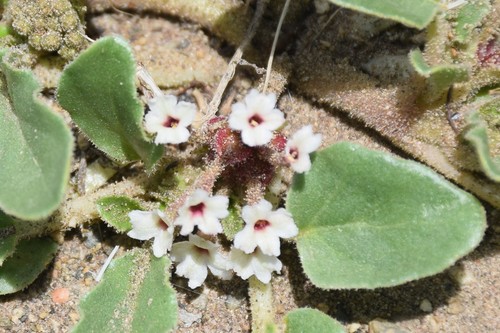


Small-Flowered Sand-Verbena
tripterocalyx micranthus
The Small-Flowered Sand-Verbena is an intriguing, low-growing annual herb specially adapted to life in shifting sand dunes and dry plains across western North America. Belonging to the four o'clock family, this resilient plant plays a vital role in colonizing loose sand, helping to stabilize fragile dune ecosystems. Its small, delicate blooms and unique sticky texture make it a fascinating subject for native plant enthusiasts. Despite its name, it is not a true verbena. Instead, it captures attention with its remarkable clusters of winged fruits that resemble tiny, papery lanterns designed to catch prairie winds.
Hábitat: Typically found in semi-active to active sand dunes, sandy plains, and eroding sandy slopes.
This low-growing plant features branching stems covered in sticky, glandular hairs that often collect fine sand. Its opposite leaves are oval to lance-shaped with smooth margins. The flowers are small, greenish-white to pale pink, arranged in tight, rounded heads. The most distinctive feature is the fruit cluster, consisting of straw-colored to rosy-pink, heavily veined, three-winged papery envelopes that enclose the seeds.
Categoría
PlantasRareza
Common
Peligro
1/5 · Muy bajo
Snaps
¡Sé la primera persona en hacer un snap!
It is a true specialist of shifting sand dunes, thriving in harsh environments where most other plants would perish.
Its genus name, Tripterocalyx, means 'three-winged calyx,' describing the papery wings on its fruits.
The sticky coating on its stems and leaves acts like natural flypaper, trapping insects and sand to deter larger herbivores.
Glandular hairs trap sand grains, forming a physical barrier that deters herbivores and reduces moisture loss.
Its prominent three-winged fruits act as sails, allowing the wind to transport seeds across open sand dunes.
Seeds can remain dormant in dry sand for years, germinating rapidly only when moisture conditions are ideal.
As a photosynthetic plant, it generates its own energy from sunlight, carbon dioxide, water, and soil nutrients.
Osmia
Provides nectar and pollen to native bees in sandy desert habitats.
Antilocapra americana
Occasionally grazed by native herbivores that forage in sandhill environments.
Calamovilfa longifolia
Competes for space and moisture in semi-stabilized sand dunes.
Aún no hay insignias de rasgos asignadas a este objeto.
Todavía no hay alias listados.
Las colecciones para este objeto aparecerán aquí a medida que se añadan más temas.
Peligro
1/5 · Muy bajo
Todavía no hay notas especiales de seguridad.
La forma más fácil de identificar a Small-Flowered Sand-Verbena es usar la aplicación de identificación de naturaleza Snappit.
10-50 cm
1 años
As a photosynthetic plant, it generates its own energy from sunlight, carbon dioxide, water, and soil nutrients.
Typically found in semi-active to active sand dunes, sandy plains, and eroding sandy slopes.
Acércate para separar los grupos y explorar dónde se ha fotografiado este objeto.
Los snaps recientes aparecerán aquí a medida que se añadan nuevas observaciones.