

Snow Squarestem
melanthera nivea
The Snow Squarestem (Melanthera nivea) is an herbaceous perennial wildflower that brings a flurry of pollinator activity to the southeastern United States and the Caribbean. Belonging to the aster family, this robust plant is celebrated for its remarkable ability to attract an incredible diversity of butterflies, bees, and other beneficial insects. Unlike the classic daisy, it skips the showy outer petals entirely, offering instead a bounty of nectar-rich, pure white flower heads that resemble tiny snowballs. What makes the Snow Squarestem particularly fascinating is its physical structure; it possesses distinctively square, rigid stems—a trait usually reserved for the mint family. Thriving in harsh, dry environments like pine rocklands and coastal dunes, it stands as a resilient and vital ecological anchor, providing year-round sustenance for local wildlife.
Hábitat: Found primarily in well-drained, sandy soils of pine rocklands, coastal hammocks, open woodlands, and sunny disturbed sites.
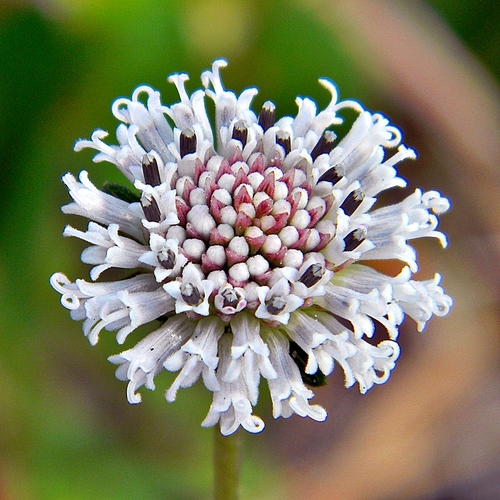
Melanthera nivea typically grows 50 to 150 centimeters tall and is most easily identified by its sharply four-angled, square stem, which is often mottled with purple. Its green, rough-textured, opposite leaves are deltoid to ovate with jagged, serrated edges. The blooms are small, spherical, button-like flower heads consisting entirely of white to cream-colored disc florets, completely lacking the long ray petals seen on typical sunflowers. These fuzzy-looking white heads are speckled with prominent dark brown or black anthers, giving them a distinctively snowy, dotted appearance.
Categoría
PlantasRareza
Common
Peligro
1/5 · Muy bajo
Snaps
¡Sé la primera persona en hacer un snap!
Because it completely lacks the colorful outer 'ray' petals of a traditional daisy, its flowers look like tiny, fuzzy white buttons perched at the top of the stems.
Despite its square stems—a hallmark trait usually used to identify members of the mint family—the Snow Squarestem actually belongs to the sunflower and daisy family.
It is renowned among native landscapers in Florida as an absolute 'must-have' for butterfly gardens, capable of attracting dozens of different pollinator species in a single afternoon.
The specific epithet 'nivea' translates to 'snowy' in Latin, perfectly describing the fluffy, pure white appearance of its blooming flower heads.
Features rigid, four-angled stems that provide exceptional structural support against strong coastal winds.
Possesses a deep root system and hardy structure that allows it to thrive in dry, nutrient-poor sandy soils.
Produces copious amounts of nectar almost continuously year-round in frost-free zones, drawing dense crowds of pollinators.
As a photoautotroph, it synthesizes its own food using sunlight, water, and carbon dioxide.
Eumaeus atala
Heavily relies on this plant's nectar as a primary food source in pine rockland habitats.
Heliconius charithonia
Frequently visits the white flower heads to extract nectar during daytime foraging.
Aphis gossypii
Often found feeding on the sap of the plant's tender new stem growth.
Aún no hay insignias de rasgos asignadas a este objeto.
Todavía no hay alias listados.
Las colecciones para este objeto aparecerán aquí a medida que se añadan más temas.
Peligro
1/5 · Muy bajo
Todavía no hay notas especiales de seguridad.
La forma más fácil de identificar a Snow Squarestem es usar la aplicación de identificación de naturaleza Snappit.
50-150 cm
3-10 años
As a photoautotroph, it synthesizes its own food using sunlight, water, and carbon dioxide.
Found primarily in well-drained, sandy soils of pine rocklands, coastal hammocks, open woodlands, and sunny disturbed sites.
Acércate para separar los grupos y explorar dónde se ha fotografiado este objeto.
Los snaps recientes aparecerán aquí a medida que se añadan nuevas observaciones.














