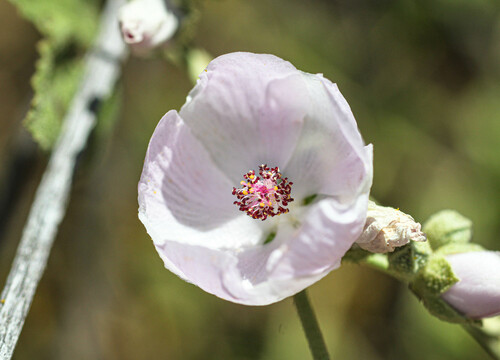


Southern Coastal Bushmallow
malacothamnus fasciculatus
The Southern Coastal Bushmallow is a fast-growing, evergreen shrub native to the chaparral and coastal sage scrub communities of southern California and northern Baja California. Known for its remarkable resilience, this woody plant plays a critical ecological role in post-fire recovery, rapidly regenerating to stabilize slopes and prevent soil erosion. During its peak blooming season, the bush becomes adorned with clusters of delicate, rose-pink to lavender blossoms, providing a crucial nectar source for native bees, butterflies, and other pollinators. Its unique velvety foliage and robust nature make it a beloved specimen in water-wise native gardening.
Hábitat: Found on dry, sunny hillsides, canyon slopes, and disturbed areas within coastal sage scrub and chaparral ecosystems.
This shrub grows into a rounded, multi-stemmed form typically reaching 1 to 5 meters in height. Its arching woody branches are densely covered in tiny, star-shaped hairs, giving the entire plant a soft, dusty grey-green or silvery-white appearance. The leaves are shallowly lobed, resembling small maple leaves, and are rough to the touch. The striking flowers are cup-shaped, measuring about 2 to 3 centimeters across, with pale pink to lavender-rose petals and a central cluster of bright yellow stamens, clustered tightly along the upper leaf axils.
Categoría
PlantasRareza
Common
Peligro
1/5 · Muy bajo
Snaps
¡Sé la primera persona en hacer un snap!
It is incredibly drought-tolerant, relying on its deep root system to access water during the dry California summers.
Its rapid post-fire growth makes it one of the most effective natural tools for preventing mudslides on steep, burned hillsides.
The scientific name Malacothamnus is derived from the Greek words for 'soft shrub', describing the velvety texture of its foliage.
The seed coats are highly heat-resistant and require the intense heat of a wildfire to scarify them, triggering rapid post-fire germination.
Leaves are covered in dense, star-shaped trichomes that reflect excess sunlight, reduce wind speed across the leaf surface, and minimize water loss.
Possesses a vigorous underground root system capable of rapidly sending up new shoots after the upper plant has been damaged by fire or drought.
This species produces its own food through photosynthesis, utilizing sunlight, carbon dioxide from the air, and water and minerals absorbed through its root system.
Vanessa annabella
Serves as a critical larval host plant where caterpillars feed on the leaves.
Bombus crotchii
Forages on the nectar and pollen of the blossoms, serving as a primary pollinator.
Sylvilagus audubonii
Feeds on the leaves and young shoots of the bush as part of its generalist herbivore diet.
Aún no hay insignias de rasgos asignadas a este objeto.
Todavía no hay alias listados.
Las colecciones para este objeto aparecerán aquí a medida que se añadan más temas.
Peligro
1/5 · Muy bajo
Todavía no hay notas especiales de seguridad.
La forma más fácil de identificar a Southern Coastal Bushmallow es usar la aplicación de identificación de naturaleza Snappit.
100-500 cm
5-25 años
This species produces its own food through photosynthesis, utilizing sunlight, carbon dioxide from the air, and water and minerals absorbed through its root system.
Found on dry, sunny hillsides, canyon slopes, and disturbed areas within coastal sage scrub and chaparral ecosystems.
Acércate para separar los grupos y explorar dónde se ha fotografiado este objeto.
Los snaps recientes aparecerán aquí a medida que se añadan nuevas observaciones.




_1_(24790682337).jpg&width=800)




.jpg&width=800)



