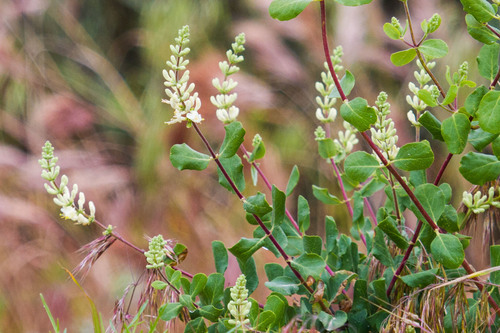


Southern Honeysuckle
lonicera subspicata
The Southern Honeysuckle (Lonicera subspicata) is an endearing evergreen shrub or climbing vine native to the chaparral and coastal sage scrub communities of southern California and Baja California. With its sprawling growth habit, it weaves gracefully through neighboring shrubs, offering year-round structure and lush greenery to arid landscapes. During the spring and summer months, it becomes a focal point of ecological activity, bursting with clusters of fragrant, cream-colored flowers that attract a wealth of native pollinators. This resilient plant is highly adapted to the Mediterranean climate, surviving dry, hot summers with ease. It plays a vital role in its native ecosystem by providing shelter and forage for local wildlife, from hummingbirds sipping its rich nectar to small mammals feeding on its bright berries.
Hábitat: Found in dry chaparral, coastal sage scrub, and oak woodland habitats, often clinging to sunny hillsides.
This woody evergreen shrub typically grows between 100 and 250 centimeters tall, often using nearby vegetation for support as a climbing vine. Its opposite, leathery leaves are oval to round, measuring 1 to 4 centimeters in length, with dark green upper surfaces and pale, often hairy undersides. The pale yellow to cream-colored flowers are two-lipped and arranged in dense, spike-like terminal clusters. Following successful pollination, the flowers give way to small, glossy berries that transition from yellow to a vibrant orange or red.
Categoría
PlantasRareza
Common
Peligro
1/5 · Muy bajo
Snaps
¡Sé la primera persona en hacer un snap!
Indigenous peoples of California traditionally used the strong, flexible stems of honeysuckle species for weaving and constructing items like cradles and baskets.
Its scientific name, subspicata, refers to the spiked arrangement of its pale yellow flower clusters.
Unlike some exotic honeysuckles that are highly invasive, Southern Honeysuckle is a well-behaved native species essential to the Southern California chaparral ecosystem.
Features leathery, hairy leaves designed to minimize water loss, allowing it to survive extreme Mediterranean summer droughts.
Possesses a robust underground root crown that allows the plant to quickly regenerate and sprout new growth after wildfire burns the upper foliage.
Uses flexible, vine-like branches to scramble over and through sturdier shrubs to reach sunlight in dense brush environments.
As a photoautotrophic plant, the Southern Honeysuckle produces its own food through photosynthesis, utilizing sunlight, water, and carbon dioxide.
Calypte anna
Pollinates the flowers while feeding on the sweet nectar.
Odocoileus hemionus
Browses on the evergreen leaves and tender young twigs during the dry season.
Zonotrichia leucophrys
Feeds on the ripe berries in late summer and disperses the seeds through droppings.
Aún no hay insignias de rasgos asignadas a este objeto.
Todavía no hay alias listados.
Las colecciones para este objeto aparecerán aquí a medida que se añadan más temas.
Peligro
1/5 · Muy bajo
Todavía no hay notas especiales de seguridad.
La forma más fácil de identificar a Southern Honeysuckle es usar la aplicación de identificación de naturaleza Snappit.
100-250 cm
10-50 años
As a photoautotrophic plant, the Southern Honeysuckle produces its own food through photosynthesis, utilizing sunlight, water, and carbon dioxide.
Found in dry chaparral, coastal sage scrub, and oak woodland habitats, often clinging to sunny hillsides.
Acércate para separar los grupos y explorar dónde se ha fotografiado este objeto.
Los snaps recientes aparecerán aquí a medida que se añadan nuevas observaciones.
















_Valerianella_locusta_-_inflorescences_and_Leaf.jpg&width=800)