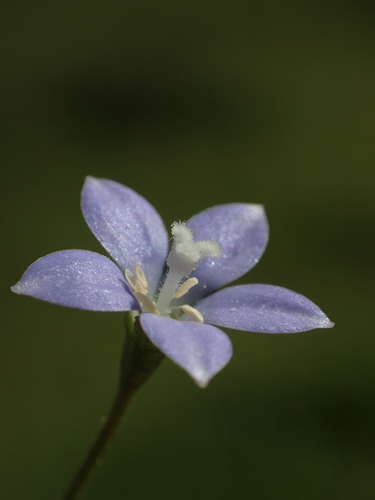


Southern Rockbell
wahlenbergia marginata
The Southern Rockbell (Wahlenbergia marginata) is a delicate, perennial herb native to East Asia, Australia, and New Zealand. Belonging to the bellflower family (Campanulaceae), this resilient plant is often found in disturbed soils, rocky outcrops, and grassy fields. Despite its fragile appearance, it is remarkably hardy, surviving in harsh, nutrient-poor conditions where other plants might struggle. It is widely recognized by its charming, bell-shaped blue-to-violet flowers that sway gently on thin, wiry stems, bringing a splash of color to barren grounds.
Hábitat: Found in open grassy areas, sandy coastlines, rocky slopes, and disturbed soils such as roadsides.
This slender herb typically grows between 10 to 60 cm tall, featuring erect, often branched, wiry stems. Its leaves are narrow, lance-shaped, and usually have wavy or finely serrated margins, especially near the base of the plant. The striking flowers are bell-shaped, measuring about 1 to 1.5 cm across, with five pointed petals that range in color from a pale sky blue to a deep violet, sometimes appearing almost white at the center.
Categoría
PlantasRareza
Common
Peligro
1/5 · Muy bajo
Snaps
¡Sé la primera persona en hacer un snap!
In some regions, the plant is considered a harmless lawn weed because of its ability to thrive in mowed turf and pavement cracks.
Its flowers are highly sensitive to sunlight, opening wide during bright days and closing during overcast weather or at night.
The genus name Wahlenbergia honors Georg Wahlenberg, a famous Swedish botanist and professor.
Can withstand prolonged periods of dry conditions by reducing transpiration and utilizing its deep taproot system to access subterranean water.
Rapidly colonizes disturbed soils and gravelly terrains, helping to stabilize loose soil surfaces before other plants can settle.
Its flowers close during dark or overcast periods to protect its pollen from moisture and open only during bright, sunny hours.
As a photoautotroph, the Southern Rockbell manufactures its own nutrients through photosynthesis, using sunlight, carbon dioxide, and water.
Apis mellifera
The Western Honey Bee acts as a major pollinator, attracted to the bright blue petals.
Oryctolagus cuniculus
The European Rabbit occasionally grazes on the leaves and stems of the plant.
Aún no hay insignias de rasgos asignadas a este objeto.
Todavía no hay alias listados.
Las colecciones para este objeto aparecerán aquí a medida que se añadan más temas.
Peligro
1/5 · Muy bajo
Todavía no hay notas especiales de seguridad.
La forma más fácil de identificar a Southern Rockbell es usar la aplicación de identificación de naturaleza Snappit.
10-60 cm
1-5 años
As a photoautotroph, the Southern Rockbell manufactures its own nutrients through photosynthesis, using sunlight, carbon dioxide, and water.
Found in open grassy areas, sandy coastlines, rocky slopes, and disturbed soils such as roadsides.
Foraging
Acércate para separar los grupos y explorar dónde se ha fotografiado este objeto.
Los snaps recientes aparecerán aquí a medida que se añadan nuevas observaciones.




















.jpg&width=800)

