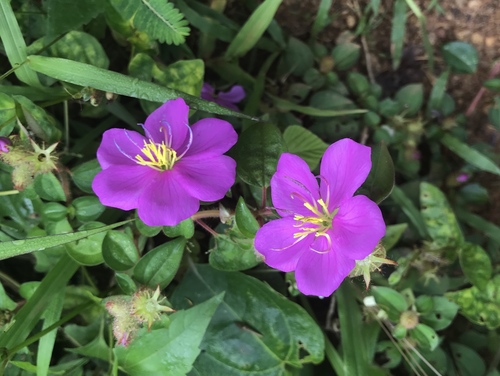


Spanish Shawl
heterotis rotundifolia
Spanish Shawl (Heterotis rotundifolia), formerly known as Dissotis rotundifolia, is a vibrant, low-growing evergreen perennial plant native to tropical Africa. Widely appreciated for its rapid growth and ornamental value, it forms a dense, cascading carpet of soft, hairy leaves decorated with striking pink-to-purple flowers. It belongs to the Melastomataceae family, which is renowned for its unique floral morphology and specific pollination mechanisms. This resilient plant is an exceptional groundcover that thrives in moist, tropical, and subtropical climates.
Hábitat: Typically found in moist, shady forest edges, riverbanks, wetlands, and disturbed areas across tropical regions.
This creeping herb features slender, reddish stems that root easily at the nodes. Its opposite, oval-to-round leaves are 2 to 3 centimeters long, bright green, covered in fine velvety hairs, and display 3 to 5 distinct, longitudinal veins running from the base to the tip. The solitary flowers are 3 to 5 centimeters in diameter, showcasing five wide, bright magenta-pink petals and highly conspicuous, curved stamens with bi-colored yellow and purple appendages that protrude elegantly from the center.
Categoría
PlantasRareza
Common
Peligro
1/5 · Muy bajo
Snaps
¡Sé la primera persona en hacer un snap!
Because it spreads so quickly and can grow from tiny stem fragments, it is classified as an invasive weed in several tropical islands, including Hawaii.
Despite its common name 'Spanish Shawl', this plant is completely native to tropical Africa and has no historical origin in Spain.
It belongs to the family Melastomataceae, which is characterized by leaves with distinctive longitudinal veins that run parallel from base to tip.
Stems produce roots at almost every node that contacts moist soil, allowing the plant to rapidly anchor itself, spread horizontally, and colonize new ground.
Possesses specialized, hinged stamens that safely store pollen until specific bees vibrate their flight muscles at the correct frequency to release it.
Can regenerate entire plants from small, broken stem fragments, making it highly resilient to trampling and physical disturbance.
As a photoautotrophic plant, it synthesizes its own organic compounds from carbon dioxide and water using light energy absorbed by chlorophyll.
Xylocopa caffra
Buzz-pollinated by large bees capable of sonication to release pollen from its pores.
Spodoptera littoralis
Leaves are occasionally consumed by the larvae of various noctuid moths.
Sphagneticola trilobata
Competes vigorously for space and soil moisture in disturbed habitats and garden beds.
Aún no hay insignias de rasgos asignadas a este objeto.
Todavía no hay alias listados.
Las colecciones para este objeto aparecerán aquí a medida que se añadan más temas.
Peligro
1/5 · Muy bajo
Todavía no hay notas especiales de seguridad.
La forma más fácil de identificar a Spanish Shawl es usar la aplicación de identificación de naturaleza Snappit.
10-30 cm
2-10 años
As a photoautotrophic plant, it synthesizes its own organic compounds from carbon dioxide and water using light energy absorbed by chlorophyll.
Typically found in moist, shady forest edges, riverbanks, wetlands, and disturbed areas across tropical regions.
Acércate para separar los grupos y explorar dónde se ha fotografiado este objeto.
Los snaps recientes aparecerán aquí a medida que se añadan nuevas observaciones.









.jpg&width=800)

