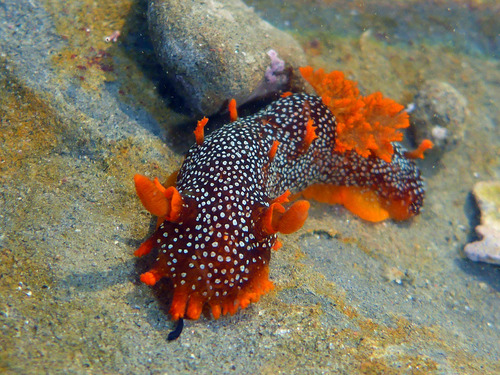


Spotted Dorid
triopha maculata
The Spotted Dorid, Triopha maculata, is a captivating species of sea slug, renowned for its striking appearance and intriguing biology. As a nudibranch, it belongs to a diverse group of shell-less marine gastropods, often called 'sea slugs' for their soft bodies and lack of external shells in adulthood. This particular dorid captivates underwater observers with its vibrant coloration and unique texture, making it a favorite among divers and tide pool enthusiasts. It plays an important role in its marine ecosystem, primarily as a specialized predator of certain sessile invertebrates, contributing to the balance of coastal communities. Its delicate beauty and fascinating adaptations highlight the incredible biodiversity found in the cold waters of the Pacific Northwest.
Hábitat: The Spotted Dorid is typically found in subtidal and intertidal zones, inhabiting rocky reefs, kelp forests, and tide pools along the Pacific coast.
The Spotted Dorid features a creamy white to pale yellow body adorned with prominent, irregularly shaped orange or reddish-orange spots, which give it its common name. Its dorsal surface is covered with numerous conical papillae, often tipped with the same orange coloration, giving it a somewhat bumpy or 'spotted' texture. Two distinctive orange, finger-like oral tentacles protrude from the front of its head, aiding in navigation and food detection. A pair of tall, club-shaped rhinophores, typically orange with white tips, are located on its head and used for chemosensory detection. At its posterior end, a cluster of feathery gills, also orange and often outlined in white, is visible.
Categoría
InvertebrateRareza
Common
Peligro
1/5 · Muy bajo
Snaps
¡Sé la primera persona en hacer un snap!
Despite their slug-like appearance, nudibranchs are distinct from terrestrial slugs and snails. They are marine-only creatures and are some of the most colorful animals in the ocean.
Like many nudibranchs, the Spotted Dorid has both male and female reproductive organs, making it a hermaphrodite. During mating, two individuals exchange sperm to fertilize each other's eggs.
The name 'nudibranch' means 'naked gills,' referring to the exposed respiratory structures on the back of many species, which are often feathery and vibrantly colored.
This dorid uses its prominent rhinophores to detect chemical cues in the water, enabling it to locate its specific prey species, primarily bryozoans, and navigate its environment.
Its bright orange spots and overall vibrant appearance serve as a warning to potential predators. This aposematic coloration suggests that the dorid may be unpalatable or toxic, deterring attacks.
The Spotted Dorid is a highly specialized feeder, primarily preying on a limited range of bryozoan species. This selective diet helps it efficiently acquire nutrients from a specific food source.
The Spotted Dorid is a specialized carnivore, primarily preying on colonial invertebrates found on hard substrates. It uses its radula to graze on its chosen food source.
Membranipora membranacea
Primary food source, grazed upon by the dorid.
Cancer productus
Potential predator of various nudibranchs, including the Spotted Dorid.
Scorpaenichthys marmoratus
Some fish species may occasionally prey on nudibranchs, though they are often avoided due to toxicity.
Aún no hay insignias de rasgos asignadas a este objeto.
Todavía no hay alias listados.
Las colecciones para este objeto aparecerán aquí a medida que se añadan más temas.
Peligro
1/5 · Muy bajo
Todavía no hay notas especiales de seguridad.
La forma más fácil de identificar a Spotted Dorid es usar la aplicación de identificación de naturaleza Snappit.
2-7 cm
0.001-0.01 kg
1-2 años
The Spotted Dorid is a specialized carnivore, primarily preying on colonial invertebrates found on hard substrates. It uses its radula to graze on its chosen food source.
The Spotted Dorid is typically found in subtidal and intertidal zones, inhabiting rocky reefs, kelp forests, and tide pools along the Pacific coast.
Foraging
5000-50000
Acércate para separar los grupos y explorar dónde se ha fotografiado este objeto.
Los snaps recientes aparecerán aquí a medida que se añadan nuevas observaciones.














