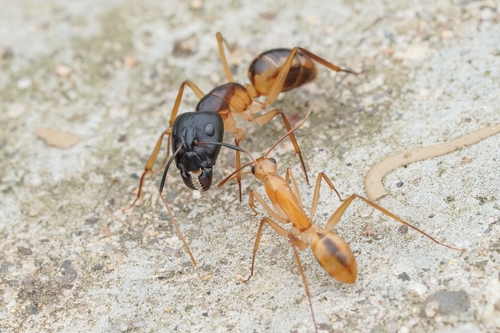


Spotted Sugar Ant
camponotus maculatus
The Spotted Sugar Ant (Camponotus maculatus) is a highly adaptive and widespread species of carpenter ant found throughout Africa and parts of southern Asia. These social insects are well-known for their nocturnal lifestyle and their fascinating division of labor within the colony. The species exhibits strong polymorphism, with large major workers possessing massive heads and powerful mandibles for defense, while smaller minor workers manage foraging and brood care. Their nests are typically established under rocks, logs, or in dry soil, making them a common sight in arid and semi-arid landscapes. They are vital ecological scavengers and play a crucial role in managing pest populations in their environments.
Hábitat: Typically found in semi-arid savannahs, open woodlands, and grasslands, nesting under stones, in dry soil, or within decaying wood.
These ants are characterized by their striking color contrast, featuring a dark brown to black head and thorax with a lighter yellowish-brown gaster. The gaster is distinctively marked with pale, cream-colored, or yellow spots on the sides, which serve as a primary identification mark in the field. Due to worker polymorphism, their sizes vary significantly, with minor workers starting around 6 millimeters and major workers reaching up to 18 millimeters in length. They possess long, slender legs and antennae adapted for navigating in darkness.
Categoría
InsectosRareza
Common
Peligro
1/5 · Muy bajo
Snaps
¡Sé la primera persona en hacer un snap!
Despite their sweet-sounding name, major workers can deliver a surprisingly strong and painful bite if their nest is disturbed.
The distinctive pale spots on their gaster may act as disruptive camouflage, breaking up their outline under moonlight.
They utilize highly complex pheromone trails to coordinate mass foraging events in total darkness.
When threatened, these ants can spray formic acid from the tip of their abdomen to deter predators and subdue enemies.
The colony produces workers of highly diverse sizes, allowing individuals to specialize in heavy defense or efficient foraging.
They cultivate mutualistic relationships with sap-sucking insects like aphids, protecting them in exchange for sweet honeydew.
Mainly feeds on sweet liquids like floral nectar and honeydew, supplemented by hunting dead or live insects for protein.
Diferencias por edad: Larvae require a highly proteinaceous diet of insect parts for development, while adult ants feed almost exclusively on carbohydrate-rich liquids.
Aphis craccivora
The ants protect the aphids from predators in exchange for sugar-rich honeydew.
Myrmeleon obscurus
Antlion larvae construct conical sand traps to capture and consume foraging sugar ants.
Hodotermes mossambicus
Compete for nesting sites and foraging territories within shared dry savannah habitats.
Aún no hay insignias de rasgos asignadas a este objeto.
Todavía no hay alias listados.
Las colecciones para este objeto aparecerán aquí a medida que se añadan más temas.
Peligro
1/5 · Muy bajo
Todavía no hay notas especiales de seguridad.
La forma más fácil de identificar a Spotted Sugar Ant es usar la aplicación de identificación de naturaleza Snappit.
1-2 cm
0.00001-0.00005 kg
1-15 años
Mainly feeds on sweet liquids like floral nectar and honeydew, supplemented by hunting dead or live insects for protein.
Typically found in semi-arid savannahs, open woodlands, and grasslands, nesting under stones, in dry soil, or within decaying wood.
Foraging
20-100
Acércate para separar los grupos y explorar dónde se ha fotografiado este objeto.
Los snaps recientes aparecerán aquí a medida que se añadan nuevas observaciones.



_(53166727507).jpg&width=800)