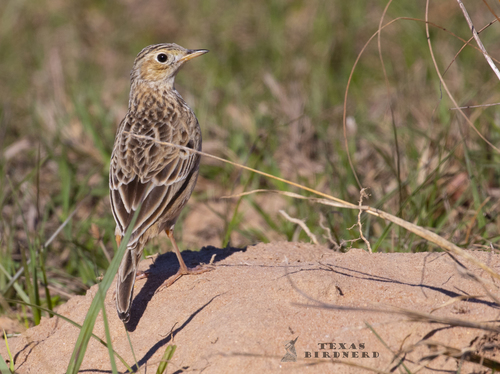


Sprague'S Pipit
anthus spragueii
Sprague's Pipit is a small, elusive songbird that is often heard long before it is seen. Strongly tied to the native shortgrass and mixed-grass prairies of North America, this highly cryptic species is a master of camouflage. While grounded, they are notoriously difficult to spot, seamlessly blending into the dry vegetation of their habitat. However, during the breeding season, males transform from secretive ground-dwellers into spectacular aerial performers, ascending high into the sky to deliver an endless, cascading song. Sadly, their strict dependence on untouched native grasslands has made them a prominent conservation concern as agriculture and development continue to fragment their habitat.
Hábitat: Typically found in expansive, native shortgrass and mixed-grass prairies with moderate litter depth and little to no shrub cover.
Sprague's Pipits are small, sparrow-sized birds with a highly cryptic plumage designed to blend into dry prairie grasses. They feature heavily streaked brown and buff upperparts, contrasting with relatively pale, whitish underparts that have fine, distinct blackish streaking on the breast. Their faces show a plain expression with large, dark eyes surrounded by a prominent pale eye-ring. Their legs are relatively long and pale pinkish-brown, suited for walking rather than hopping, and their thin, pointed bill is typical of insectivorous songbirds. When flushed into flight, white outer tail feathers are visibly contrasting against the rest of their dark tail.
Categoría
AvesRareza
Common
Peligro
1/5 · Muy bajo
Snaps
¡Sé la primera persona en hacer un snap!
A male Sprague's Pipit holds the record for the longest known flight display of any bird species, with one individual recorded singing in the air for 3 hours without landing.
Because they are so incredibly hard to spot on the ground, early ornithologists and birders affectionately dubbed them 'the bird that sings high in the sky.'
They are notoriously picky about their real estate, almost exclusively breeding in native prairie grasses and routinely abandoning areas that have been seeded with introduced, non-native grasses.
When flushed from the grass, a Sprague's Pipit will rarely fly to a nearby fence or bush; instead, it typically flies high into the air in an undulating pattern or drops straight back down into the grass to hide.
Males can sing continuously while hovering high in the air for up to three hours, which is the longest known flight display of any bird.
Their heavily streaked brown and buff plumage perfectly mimics the shadows and textures of dry prairie grasses, making them nearly invisible to predators.
Unlike many small songbirds that hop, Sprague's Pipits exclusively walk or run along the ground to navigate dense prairie vegetation efficiently.
They primarily consume terrestrial arthropods during the summer breeding season, supplementing their diet with grass and weed seeds during migration and winter.
Diferencias por edad: Nestlings are fed exclusively a diet of soft-bodied insects like caterpillars and small grasshoppers.
Circus hudsonius
Harriers patrol the low prairie grasses, acting as a natural predator of adult pipits and their fledglings.
Molothrus ater
Cowbirds are brood parasites that occasionally lay their eggs in the pipit's well-hidden ground nests.
Melanoplus differentialis
An important high-protein insect food source for adult pipits and their growing chicks during the breeding season.
Aún no hay insignias de rasgos asignadas a este objeto.
Todavía no hay alias listados.
Las colecciones para este objeto aparecerán aquí a medida que se añadan más temas.
Peligro
1/5 · Muy bajo
Todavía no hay notas especiales de seguridad.
La forma más fácil de identificar a Sprague'S Pipit es usar la aplicación de identificación de naturaleza Snappit.
15-17 cm
25-28 cm
0.022-0.026 kg
2-5 años
They primarily consume terrestrial arthropods during the summer breeding season, supplementing their diet with grass and weed seeds during migration and winter.
Typically found in expansive, native shortgrass and mixed-grass prairies with moderate litter depth and little to no shrub cover.
Foraging
Acércate para separar los grupos y explorar dónde se ha fotografiado este objeto.
Los snaps recientes aparecerán aquí a medida que se añadan nuevas observaciones.





.jpg&width=800)









