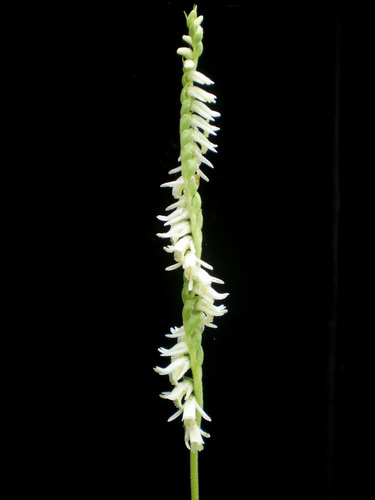


Spring Ladies' Tresses
spiranthes vernalis
Spiranthes vernalis, commonly known as Spring Ladies' Tresses, is an elegant and fascinating terrestrial orchid native to North America. Characterized by a distinctive spiral of delicate, crystalline white flowers climbing up a singular stalk, this species adds a touch of architectural beauty to grassy meadows and open woodlands. Its specific epithet, "vernalis," highlights its springtime blooming period, which typically peaks between March and July depending on the latitude. This early appearance helps distinguish it from many of its autumn-flowering relatives in the Spiranthes genus. Like many native orchids, it has complex ecological relationships, relying on highly specific soil fungi to germinate and grow, as its microscopic seeds contain almost no nutritional reserves. Finding a colony of these spiraling blossoms swaying in a spring breeze is a thrilling reward for nature enthusiasts exploring wet prairies and sun-drenched clearings.
Hábitat: Found in moist to wet meadows, coastal prairies, bogs, open woodlands, and along grassy roadside ditches with acidic soils.
Spring Ladies' Tresses grows as an erect, slender stem reaching 15 to 60 centimeters in height. The inflorescence consists of a dense, twisted spike of small, tubular, white to yellowish-white flowers, each featuring a slightly ruffled lip. A key identifying feature of Spiranthes vernalis is the dense covering of pointed, multicellular hairs (pubescence) on the upper stem and among the flowers, distinguishing it from smoother species. The plant typically features narrow, grass-like basal leaves that are usually still present and green when the flowers bloom in the spring.
Categoría
PlantasRareza
Common
Peligro
1/5 · Muy bajo
Snaps
¡Sé la primera persona en hacer un snap!
Orchid seeds, including those of the Spring Ladies' Tresses, are some of the smallest seeds in the world, often resembling fine particles of dust.
The genus name 'Spiranthes' comes from the Greek words 'speira' (spiral) and 'anthos' (flower), perfectly describing the plant's twisted floral stalk.
The spiral arrangement of flowers forces bees to start at the bottom and work their way up, which helps prevent the plant from pollinating itself.
Unlike many other Ladies' Tresses species that wait until late summer or fall to bloom, the 'vernalis' species lives up to its name by blooming between March and July.
The flowers grow in a spiral pattern up the stem, a structure that guides pollinators systematically from the oldest, lowest flowers to the youngest at the top.
Its tiny seeds lack endosperm and rely entirely on a symbiotic relationship with specific soil fungi to germinate and acquire initial nutrients.
The upper portion of the stem is densely covered in fine, pointed hairs, which are believed to deter tiny crawling insects from stealing nectar without providing pollination services.
Like most plants, Spring Ladies' Tresses produces its own food through photosynthesis once mature, though it relies heavily on soil fungi for nutrient uptake during its early development.
Diferencias por edad: As a microscopic seed and underground seedling, it is entirely dependent on mycorrhizal fungi for nutrients (mycoheterotrophy) before developing above-ground leaves for photosynthesis.
Bombus impatiens
Bumblebees visit the tubular flowers to collect nectar, effectively facilitating cross-pollination as they climb the spiral.
Odocoileus virginianus
Deer occasionally graze on the tender flowering stalks and basal foliage.
Ceratobasidium cornigerum
Soil fungi provide essential nutrients to the germinating orchid seeds, which lack their own energy reserves.
Aún no hay insignias de rasgos asignadas a este objeto.
Todavía no hay alias listados.
Las colecciones para este objeto aparecerán aquí a medida que se añadan más temas.
Peligro
1/5 · Muy bajo
Todavía no hay notas especiales de seguridad.
La forma más fácil de identificar a Spring Ladies' Tresses es usar la aplicación de identificación de naturaleza Snappit.
15-60 cm
0.001-0.015 kg
3-10 años
Like most plants, Spring Ladies' Tresses produces its own food through photosynthesis once mature, though it relies heavily on soil fungi for nutrient uptake during its early development.
Found in moist to wet meadows, coastal prairies, bogs, open woodlands, and along grassy roadside ditches with acidic soils.
1000-5000
14-60 días
Acércate para separar los grupos y explorar dónde se ha fotografiado este objeto.
Los snaps recientes aparecerán aquí a medida que se añadan nuevas observaciones.










.jpg&width=800)