

Squareback Marsh Crab
armases cinereum
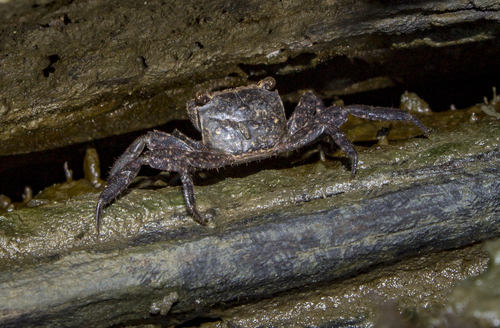
The Squareback Marsh Crab (Armases cinereum) is a small, highly active, and exceptionally agile semi-terrestrial crustacean. A familiar sight along the Atlantic and Gulf coasts of North America, these little crabs are frequently spotted scurrying up dock pilings, mangrove roots, and marsh grasses to escape the incoming tide. As opportunistic scavengers and omnivores, they play a vital role in coastal ecosystems by helping to break down detritus and cycling nutrients back into the food web. What makes the Squareback Marsh Crab particularly fascinating is its impressive transition toward a terrestrial lifestyle. Unlike fully aquatic crabs, it spends much of its life out of the water, utilizing specialized gill chambers that extract oxygen from the air as long as they remain moist. Their remarkable climbing abilities and adaptability allow them to thrive in the dynamic, ever-changing environment where land meets the sea, easily navigating both natural salt marshes and human-made waterfront structures.
Hábitat: Found primarily in coastal salt marshes, mangrove swamps, estuaries, and frequently on human-made structures like wooden docks and pilings.
This species is easily recognized by its notably boxy, flattened, and square-shaped carapace, which typically measures between 1.5 to 2.5 centimeters across. Their coloration is highly camouflaged to match their muddy, woody environments, ranging from dark brownish-gray to olive green, sometimes speckled with subtle lighter mottling. They have robust, moderately sized claws that are often slightly lighter in color, and their agile, jointed walking legs are perfectly adapted for gripping rough vertical surfaces. Their eyes are perched on short stalks located at the very front corners of their squared-off shell, giving them an expansive field of vision to detect nearby predators.
Categoría
AnimalRareza
Common
Peligro
1/5 · Muy bajo
Snaps
¡Sé la primera persona en hacer un snap!
Because they are so commonly found living on man-made waterfront structures, they are widely known by the local nickname 'wharf crabs'.
If a Squareback Marsh Crab loses a leg to a bird or raccoon, it has the ability to regenerate the missing limb over successive molts.
They are unsung heroes of the salt marsh, helping to keep the ecosystem healthy by eating decaying organic matter and recycling nutrients back into the food web.
To escape high tides and aquatic predators, these crabs will frequently climb up into the branches of coastal trees, temporarily turning into 'tree crabs'.
Adapted for exceptional vertical mobility, these crabs can rapidly scale marsh grasses, tree trunks, and wooden pilings to escape aquatic predators or rising tides.
They possess modified gill chambers that retain water, allowing them to extract oxygen directly from the air and survive extended periods on land.
They are highly adaptable to fluctuating salinity levels, enabling them to thrive in the brackish waters of estuaries where fresh and salt water constantly mix.
They are opportunistic feeders that primarily consume decaying plant matter and marsh grasses, but will also scavenge small insects and carrion.
Diferencias por edad: Larvae are planktonic filter feeders, transitioning to an omnivorous scavenging diet once they settle into their coastal habitats as juvenile crabs.
Rallus crepitans
Preyed upon by coastal bird species while foraging on exposed mudflats.
Spartina alterniflora
Relies heavily on this foundational marsh plant for food and structural habitat.
Procyon lotor
Hunted by opportunistic coastal mammals that forage along the shoreline at low tide.
Aún no hay insignias de rasgos asignadas a este objeto.
Todavía no hay alias listados.
Las colecciones para este objeto aparecerán aquí a medida que se añadan más temas.
Peligro
1/5 · Muy bajo
Todavía no hay notas especiales de seguridad.
La forma más fácil de identificar a Squareback Marsh Crab es usar la aplicación de identificación de naturaleza Snappit.
1-3 cm
0.001-0.01 kg
1-3 años
3 km/h
They are opportunistic feeders that primarily consume decaying plant matter and marsh grasses, but will also scavenge small insects and carrion.
Found primarily in coastal salt marshes, mangrove swamps, estuaries, and frequently on human-made structures like wooden docks and pilings.
Foraging
Acércate para separar los grupos y explorar dónde se ha fotografiado este objeto.
Los snaps recientes aparecerán aquí a medida que se añadan nuevas observaciones.





