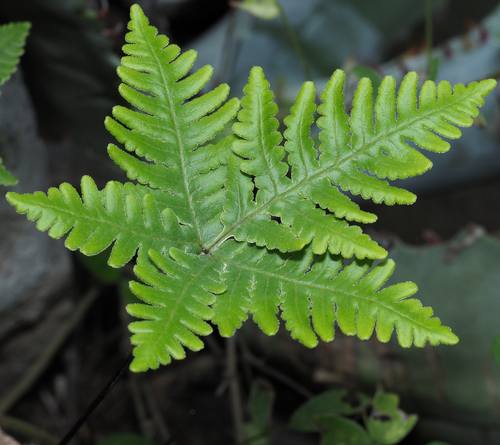


Star Cloak Fern
notholaena standleyi
The Star Cloak Fern (Notholaena standleyi) is a highly resilient, xerophytic fern native to the arid desert regions of the southwestern United States and northern Mexico. Perfectly adapted to extreme environments, this remarkable plant typically grows in dry, rocky crevices and canyon walls where soil is minimal and water is highly scarce. Its most outstanding feature is its poikilohydric nature, commonly known as a resurrection capability. During intense dry spells, the fern can lose almost all its water content and curl into a tight, dormant brown ball, only to rapidly unfurl and restore its rich green color within hours of receiving rainfall. This survival strategy allows it to thrive in desert landscapes where other fern species cannot survive, anchoring rocky substrates and providing sheltered microclimates for tiny desert organisms.
Hábitat: Found in dry, rocky crevices, canyon cliffs, and boulder fields, particularly on granitic, volcanic, or limestone substrates in desert zones.
This small perennial fern reaches heights of 5 to 25 cm, featuring distinctive pentagonal or star-shaped fronds that are deeply divided into lobed segments. The upper surface of the leaves has a dusty, grayish-green coloration when hydrated, whereas the underside is covered in a brilliant, powdery yellow or pale orange waxy coating known as farina. During periods of drought, the fronds curl tightly inward, exposing the pale, farina-coated undersides which reflect harsh desert sunlight and resemble small, compact, yellow-brown knobs tucked into rock fissures.
Categoría
PlantasRareza
Common
Peligro
1/5 · Muy bajo
Snaps
¡Sé la primera persona en hacer un snap!
Despite appearing completely dead and brittle during dry months, the plant can fully rehydrate and photosynthesize within 24 to 48 hours of rain.
Its scientific name 'Notholaena' comes from Greek words meaning 'spurious cloak', referring to the hairy or powdery margins that cover the spore cases.
The bright yellow powder (farina) on the leaves can rub off on fingers, leaving a glowing waxy outline like a stamp.
It is poikilohydric, meaning it can survive near-total dehydration by curling into a dormant ball and rapidly reviving upon contact with water.
The underside of its leaves features a waxy, yellow powdery coating that reflects intense solar radiation and minimizes water loss through transpiration.
Its fibrous, tough root system penetrates tiny rock fissures to secure the plant and extract trace moisture and minerals.
As a photosynthetic plant, it produces its own food using sunlight, carbon dioxide, and water while drawing minerals from rocky soils.
Neotoma lepida
Feeds on the fern's fronds during dry periods when other water sources are scarce.

Carnegiea gigantea
Grows in the shaded microclimates at the base of larger desert plants, which shield it from extreme heat.
Aún no hay insignias de rasgos asignadas a este objeto.
Todavía no hay alias listados.
Las colecciones para este objeto aparecerán aquí a medida que se añadan más temas.
Peligro
1/5 · Muy bajo
Todavía no hay notas especiales de seguridad.
La forma más fácil de identificar a Star Cloak Fern es usar la aplicación de identificación de naturaleza Snappit.
5-25 cm
0.01-0.05 kg
5-20 años
As a photosynthetic plant, it produces its own food using sunlight, carbon dioxide, and water while drawing minerals from rocky soils.
Found in dry, rocky crevices, canyon cliffs, and boulder fields, particularly on granitic, volcanic, or limestone substrates in desert zones.
Acércate para separar los grupos y explorar dónde se ha fotografiado este objeto.
Los snaps recientes aparecerán aquí a medida que se añadan nuevas observaciones.