

Star-Nosed Mole
condylura cristata
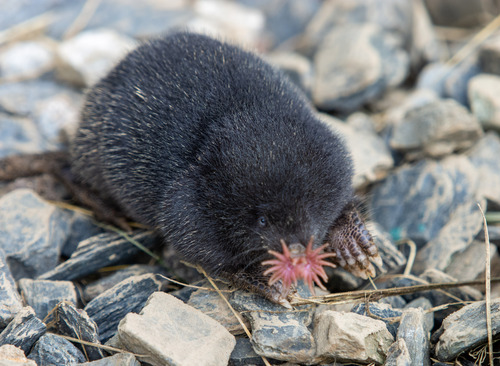
The Star-Nosed Mole (Condylura cristata) is undoubtedly one of the most bizarre and extraordinary mammals on the planet. Instantly recognizable by the ring of 22 pink, fleshy tentacles framing its snout, this semi-aquatic mole is a marvel of evolutionary adaptation. Found throughout the wetlands and damp forests of eastern North America, it spends much of its time navigating muddy shallow tunnels or diving into streams in search of invertebrate prey. Despite being functionally blind, the Star-Nosed Mole perceives its dark world with astonishing clarity. Its star functions as an ultra-sensitive tactile eye, allowing it to process physical information at lightning speeds. Fascinatingly, this species remains highly active throughout the harsh winter months, frequently swimming beneath frozen ponds to hunt. Its unique physiology and unusual appearance make it a favorite subject among biologists and nature enthusiasts alike.
Hábitat: Found in moist, low-elevation habitats like wetlands, marshes, bogs, and the muddy banks of streams and ponds.
The Star-Nosed Mole is a stout, small mammal, typically measuring 15 to 20 centimeters in length. Its most defining feature is the prominent, star-shaped appendage on its snout, which consists of 22 mobile, pink, fleshy rays. The body is covered in thick, dark brown or black water-repellent fur that keeps it dry during aquatic excursions. It has broad, scaled front paws with robust claws that face outward to aid in digging, alongside a thick, scaly tail that often becomes remarkably swollen in winter to serve as a fat reserve. Its eyes are minuscule and barely visible through the thick fur, and it lacks external ear flaps entirely.
Categoría
MamíferosRareza
Common
Peligro
1/5 · Muy bajo
Snaps
¡Sé la primera persona en hacer un snap!
Its 'star' is not a nose for smelling, but a highly advanced touch organ containing over 25,000 microscopic sensory receptors called Eimer's organs.
The mole's tail swells up to three to four times its normal size during the winter to act as a fat reserve for the harsh cold months.
The star-nosed mole is the fastest-eating mammal on Earth, able to identify and consume a meal in just 227 milliseconds.
Unlike most moles, the star-nosed mole is an excellent swimmer and actively hunts for aquatic insects and small fish in streams and ponds, even under the ice in winter.
Its star-shaped snout is covered with over 25,000 highly sensitive tactile receptors called Eimer's organs, enabling it to navigate and detect prey in total darkness.
It possesses the rare ability to smell underwater by blowing air bubbles onto submerged objects and quickly re-inhaling them to detect scent trails.
It holds the title for the fastest-eating mammal, capable of identifying, capturing, and consuming prey in less than a quarter of a second.
The Star-Nosed Mole primarily consumes small aquatic and terrestrial invertebrates found in muddy soils and shallow water bodies.
Diferencias por edad: Nursing pups transition to a soft invertebrate diet after weaning at about three to four weeks of age.
Bubo virginianus
Birds of prey commonly hunt them when they venture above ground or in shallow water.
Lumbricus terrestris
A primary prey source consumed rapidly while tunneling through muddy soils.
Vulpes vulpes
Mammalian predators occasionally dig them out of their shallow surface tunnels.
Aún no hay insignias de rasgos asignadas a este objeto.
Todavía no hay alias listados.
Las colecciones para este objeto aparecerán aquí a medida que se añadan más temas.
Peligro
1/5 · Muy bajo
Todavía no hay notas especiales de seguridad.
La forma más fácil de identificar a Star-Nosed Mole es usar la aplicación de identificación de naturaleza Snappit.
15-20 cm
0.035-0.075 kg
3-4 años
The Star-Nosed Mole primarily consumes small aquatic and terrestrial invertebrates found in muddy soils and shallow water bodies.
Found in moist, low-elevation habitats like wetlands, marshes, bogs, and the muddy banks of streams and ponds.
Foraging
2-7
Acércate para separar los grupos y explorar dónde se ha fotografiado este objeto.
Los snaps recientes aparecerán aquí a medida que se añadan nuevas observaciones.









_(46501840942).jpg&width=800)