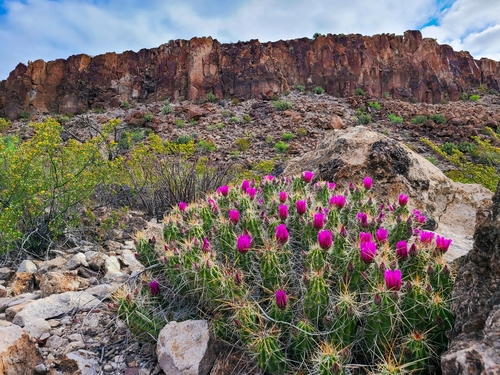


Strawberry Cactus
echinocereus enneacanthus
The Strawberry Cactus (Echinocereus enneacanthus) is a low-growing, highly clump-forming succulent native to the arid expanses of the Chihuahuan Desert. Famous for producing large, brilliant magenta flowers that can blanket entire hillsides in late spring, this plant is a striking visual highlight of desert landscapes. It gets its sweet common name from its edible, greenish-red, rounded fruits, which possess a delightful flavor reminiscent of fresh strawberries. This cactus forms massive, sprawling mounds that can survive the intense desert sun and prolonged dry spells, serving as an important source of moisture and food for native desert wildlife.
Hábitat: Thrives on arid gravelly slopes, alluvial fans, limestone hills, and shrubby desert flats.
This cactus features multiple cylindrical, pale green to yellowish-green stems that grow in dense clumps, with each stem possessing 7 to 10 prominent, slightly wavy ribs. The plant is heavily armed with clusters of sharp, yellowish-brown spines protruding from white circular areoles along the ribs. In late spring, vibrant funnel-shaped, magenta to deep purple flowers erupt near the stem tips, followed by small, egg-shaped fruits that ripen from green to a dull red and lose their outer spines when fully mature.
Categoría
PlantasRareza
Common
Peligro
1/5 · Muy bajo
Snaps
¡Sé la primera persona en hacer un snap!
A single mature plant can form a massive clump with over 100 individual stems, stretching more than a meter in diameter.
Its scientific name 'enneacanthus' translates to 'nine-spined', which references the typical cluster of spines found on each of its areoles.
The sweet, edible fruits are traditionally gathered to make flavorful local jams and jellies.
Produces a sprawling network of over a hundred interconnected stems that helps prevent soil erosion and maximizes moisture capture in dry soils.
Opens its stomata only at night to absorb carbon dioxide, dramatically reducing water loss from evaporation during hot desert days.
Features a dense armor of pale spines that shade the stem surface from intense solar radiation and create a micro-barrier against wind.
As a photosynthetic plant, it generates its own energy from sunlight, water, carbon dioxide, and essential minerals from the soil.
Lasioglossum coactum
Bees and other native pollinators visit the large magenta flowers to gather nectar, facilitating cross-pollination.
Peromyscus eremicus
Desert rodents consume the sweet, ripe strawberry-flavored fruits and aid in the dispersal of seeds across the desert floor.
Aún no hay insignias de rasgos asignadas a este objeto.
Todavía no hay alias listados.
Las colecciones para este objeto aparecerán aquí a medida que se añadan más temas.
Peligro
1/5 · Muy bajo
Todavía no hay notas especiales de seguridad.
La forma más fácil de identificar a Strawberry Cactus es usar la aplicación de identificación de naturaleza Snappit.
10+ cm
1+ kg
20+ años
As a photosynthetic plant, it generates its own energy from sunlight, water, carbon dioxide, and essential minerals from the soil.
Thrives on arid gravelly slopes, alluvial fans, limestone hills, and shrubby desert flats.
Acércate para separar los grupos y explorar dónde se ha fotografiado este objeto.
Los snaps recientes aparecerán aquí a medida que se añadan nuevas observaciones.

Texas, US
Puedes ver Leonora's Dancer y Lagartija De árbol Adornada.
Ver guía →

Texas, US
Puedes ver Texas Rainbow Cactus, Ocotillo y Greater Earless Lizard.
Ver guía →

US
Puedes ver Palo Verde Mexicano, Ocotillo y Carrizo Gigante.
Ver guía →








.jpg&width=800)







.jpg&width=800)