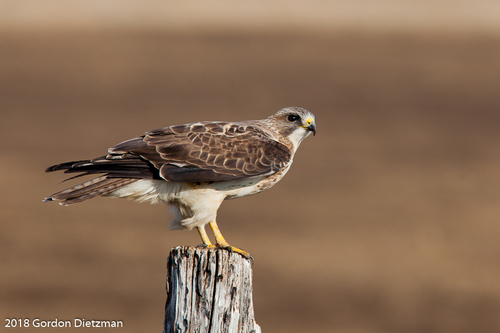


Swainson'S Hawk
buteo swainsoni
Swainson's Hawk is an elegant, medium-sized raptor of the Americas, renowned for its extraordinary long-distance migrations and its surprising dietary preferences. Often called the 'grasshopper hawk,' this bird of prey breeds in the open grasslands and agricultural fields of western North America during the summer, before embarking on an epic 10,000-kilometer journey to spend the winter in the pampas of Argentina. They are highly social raptors, frequently gathering in massive flocks numbering in the thousands during their migration corridor. While they hunt small mammals to feed their chicks during the nesting season, adult Swainson's Hawks outside of the breeding season feed almost exclusively on large insects like grasshoppers and dragonflies. This behavior makes them highly beneficial to farmers, as they provide natural pest control. Watching a flock of these graceful hawks follow a tractor in a freshly plowed field is a spectacular sight for nature lovers.
Hábitat: Typically found in wide-open country, including native grasslands, prairies, pastures, and agricultural fields of western North America.
Swainson's Hawk is characterized by its long, narrow, pointed wings and a relatively short tail. It features a highly distinctive 'bib'—a dark brown band across the breast that contrasts sharply with its white throat and pale belly. Most individuals are light-morph, showing a dark brown back, a rufous-to-brown chest bib, and underwings that have light coverts contrasting with dark flight feathers. When soaring, they hold their wings in a slight dihedral V-shape, similar to a turkey vulture.
Categoría
AvesRareza
Common
Peligro
1/5 · Muy bajo
Snaps
¡Sé la primera persona en hacer un snap!
A single flock of migrating Swainson's Hawks, known as a 'kettle', can contain tens of thousands of individual birds filling the sky.
Because they consume massive quantities of agricultural pests, they are highly welcomed by farmers and are often referred to as 'locust hawks'.
During their winter stay in Argentina, they live almost entirely in agricultural fields, feeding alongside agricultural machinery to catch flushed insects.
Undertakes one of the longest migrations of any North American raptor, traveling over 10,000 kilometers each way between northern breeding grounds and South American wintering pampas.
Saves energy during long flights by riding columns of rising warm air, allowing it to glide for hours with minimal flapping.
Possesses remarkable agility on the ground, allowing it to easily walk, run, and hop to capture grasshoppers and other large insects.
Feeds heavily on small mammals like voles and pocket gophers during the nesting season, but transitions to an almost exclusively insectivorous diet of grasshoppers and crickets during the rest of the year.
Diferencias por edad: Chicks are fed a high-protein diet consisting primarily of rodents and reptiles, whereas adults during non-breeding periods rely almost entirely on large insects.
Ictidomys tridecemlineatus
Preys heavily on this rodent during the breeding season to feed its nestlings.
Melanoplus differentialis
Consumes vast quantities of this insect pest in agricultural fields and grasslands.
Buteo jamaicensis
Competes for nesting sites and territory in open woodlands and grassland edges.
Aún no hay insignias de rasgos asignadas a este objeto.
Todavía no hay alias listados.
Las colecciones para este objeto aparecerán aquí a medida que se añadan más temas.
Peligro
1/5 · Muy bajo
Todavía no hay notas especiales de seguridad.
La forma más fácil de identificar a Swainson'S Hawk es usar la aplicación de identificación de naturaleza Snappit.
43+ cm
117+ cm
0.5+ kg
10+ años
60 km/h
Feeds heavily on small mammals like voles and pocket gophers during the nesting season, but transitions to an almost exclusively insectivorous diet of grasshoppers and crickets during the rest of the year.
Typically found in wide-open country, including native grasslands, prairies, pastures, and agricultural fields of western North America.
Acércate para separar los grupos y explorar dónde se ha fotografiado este objeto.
Los snaps recientes aparecerán aquí a medida que se añadan nuevas observaciones.

California, US
Puedes ver Lobina Negra, Birdcage Evening Primrose y Busardo Colirrojo.
Ver guía →

Nebraska, US
Puedes ver Pinzón Mexicano, Sapo De Woodhouse y Paloma Huilota.
Ver guía →

New Mexico, US
Puedes ver Girasol, Grama Bandera y Cholla Arborescente.
Ver guía →
Texas, US
Puedes ver Pavo, Correcaminos Grande y Swainson's Hawk.
Ver guía →












_female%2C_breeding_plumage.jpg&width=800)

.jpg&width=800)

