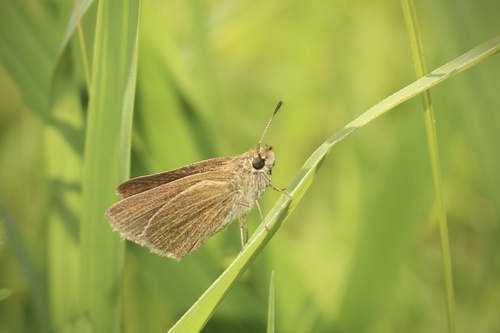


Swarthy Skipper
nastra lherminier
The Swarthy Skipper (Nastra lherminier) is a small, energetic butterfly belonging to the 'grass skipper' subfamily. Known for its rapid and erratic flight, it is a common inhabitant of open, grassy areas across the eastern United States. Despite its unassuming brown coloration, this species plays an important role in its ecosystem as both a pollinator and a food source. Its life cycle, from egg to caterpillar to chrysalis and finally to an adult butterfly, is a testament to the intricate transformations within the insect world. Spotting a Swarthy Skipper often requires a keen eye due to its swift movements and cryptic appearance, making it a rewarding discovery for nature enthusiasts.
Hábitat: Found in various open, sunny habitats including fields, meadows, roadsides, woodland edges, and powerline clearings.
This small butterfly typically has an overall dark brown appearance. The upperside of its wings is uniformly dark with minimal markings, though some individuals may exhibit faint, dark brown spots. The underside of the hindwings is a solid dark brown, lacking any distinct spots or patterns, which is a key identifying feature distinguishing it from other similar-looking skippers. Its body is also dark brown. It possesses the characteristic chunky body and hooked antennae (club-like with a pointed tip) common to skippers, and its wings are relatively small and pointed.
Categoría
InsectosRareza
Common
Peligro
1/5 · Muy bajo
Snaps
¡Sé la primera persona en hacer un snap!
Despite their small size and dark coloration, adult Swarthy Skippers are important pollinators for many wildflowers in their habitat.
The Swarthy Skipper exhibits a very rapid, often described as 'skipping' or 'darting,' flight pattern that gave the entire family Hesperiidae their common name.
The caterpillars create small, silken shelters by folding grass blades, which helps them hide from predators and provides a microhabitat for feeding and growth.
Unlike many butterflies that hold their wings flat or together, skippers often perch with their forewings and hindwings held at different angles, creating a distinctive 'delta' shape.
Swarthy Skippers are known for their extremely fast and unpredictable flight, often darting quickly between flowers or perches. This makes them difficult for predators to catch and challenging for human observers to follow.
The caterpillars of the Swarthy Skipper construct shelters by folding and tying together blades of their host grass plants with silk. These shelters provide protection from predators and adverse weather during their developmental stages.
Adult Swarthy Skippers are highly adept at rapidly extracting nectar from small flowers. Their specialized proboscis and quick movements allow them to efficiently gather sustenance from numerous blossoms in a short period.
Adult Swarthy Skippers primarily feed on nectar from various small flowers, while their larvae are herbivorous, consuming the leaves of specific grass species.
Diferencias por edad: Yes, larvae feed on grass leaves, while adults feed on nectar.
Schizachyrium scoparium
Larval host plant
Cephalanthus occidentalis
Nectar source for adults
Asclepias syriaca
Nectar source for adults
Mantis religiosa
Predator of larvae and adults
Aún no hay insignias de rasgos asignadas a este objeto.
Todavía no hay alias listados.
Las colecciones para este objeto aparecerán aquí a medida que se añadan más temas.
Peligro
1/5 · Muy bajo
Todavía no hay notas especiales de seguridad.
La forma más fácil de identificar a Swarthy Skipper es usar la aplicación de identificación de naturaleza Snappit.
0-1 cm
2-3 cm
0.0001-0.001 kg
0 años
15 km/h
Adult Swarthy Skippers primarily feed on nectar from various small flowers, while their larvae are herbivorous, consuming the leaves of specific grass species.
Found in various open, sunny habitats including fields, meadows, roadsides, woodland edges, and powerline clearings.
Acércate para separar los grupos y explorar dónde se ha fotografiado este objeto.
Los snaps recientes aparecerán aquí a medida que se añadan nuevas observaciones.