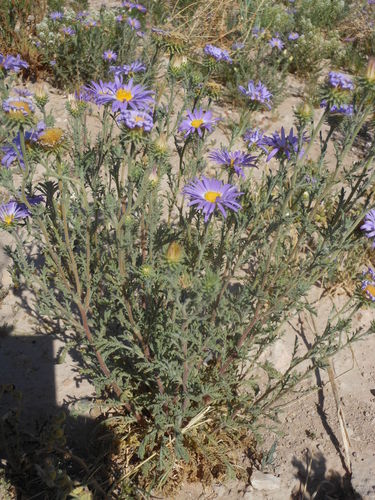


Tahoka Daisy
machaeranthera tanacetifolia
The Tahoka Daisy, scientifically known as Machaeranthera tanacetifolia, is a charming and resilient annual wildflower native to the arid and semi-arid regions of the southwestern United States and northern Mexico. Belonging to the sunflower family (Asteraceae), it is celebrated for its striking purple, daisy-like blossoms and delicate, fern-like foliage. This species plays a crucial ecological role as a nectar source for a variety of pollinators, contributing to the biodiversity of its harsh native habitats. Its ability to thrive in disturbed soils and its widespread distribution make it a familiar sight in grasslands, roadsides, and open scrublands, where it adds a splash of vibrant color from summer into fall.
Hábitat: The Tahoka Daisy is commonly found in grasslands, open woodlands, desert scrub, and often colonizes disturbed areas such as roadsides, fields, and waste grounds.
The Tahoka Daisy typically grows 15 to 60 centimeters tall, forming a bushy, erect plant. Its most distinctive features are the numerous bright purple (occasionally white) ray flowers surrounding a dense yellow central disc, resembling a classic daisy. The leaves are finely dissected, bipinnately lobed, giving them a soft, fern-like or tansy-like appearance, which is reflected in its scientific name 'tanacetifolia'. The stems are often glandular and somewhat hairy.
Categoría
PlantasRareza
Common
Peligro
1/5 · Muy bajo
Snaps
¡Sé la primera persona en hacer un snap!
Despite its delicate appearance, the Tahoka Daisy is highly adaptable and can often be found growing in nutrient-poor or compacted soils.
It is sometimes used in wildflower seed mixes for revegetation projects in arid regions due to its hardiness and ability to establish quickly.
Its bright flowers are a valuable late-season nectar source for many insect pollinators, including bees and butterflies, particularly important as other blooms fade.
The 'tanacetifolia' in its scientific name means 'with leaves like Tansy', referring to the finely dissected, fern-like appearance of its foliage.
This plant possesses adaptations such as a robust taproot system and often hairy or glandular foliage, which help it efficiently conserve water and survive in arid, dry environments.
Its showy purple flowers, rich in nectar and pollen, act as a strong attractant for a diverse array of insect pollinators, supporting local insect populations.
As an annual, the Tahoka Daisy produces a prolific number of seeds, allowing it to quickly establish and spread in disturbed soils, making it an effective pioneer species.
As a photosynthetic organism, the Tahoka Daisy produces its own food using sunlight, water, and carbon dioxide. It absorbs essential nutrients and minerals from the soil through its root system.
Apis mellifera
Pollinator, attracted to nectar and pollen.
Sylvilagus audubonii
Potential herbivore, feeding on foliage or flowers.
Danaus plexippus
Pollinator, attracted to nectar.
Peromyscus maniculatus
Potential seed predator.
Aún no hay insignias de rasgos asignadas a este objeto.
Todavía no hay alias listados.
Las colecciones para este objeto aparecerán aquí a medida que se añadan más temas.
Peligro
1/5 · Muy bajo
Todavía no hay notas especiales de seguridad.
La forma más fácil de identificar a Tahoka Daisy es usar la aplicación de identificación de naturaleza Snappit.
15-60 cm
0-1 años
As a photosynthetic organism, the Tahoka Daisy produces its own food using sunlight, water, and carbon dioxide. It absorbs essential nutrients and minerals from the soil through its root system.
The Tahoka Daisy is commonly found in grasslands, open woodlands, desert scrub, and often colonizes disturbed areas such as roadsides, fields, and waste grounds.
Foraging For Nutrients And Light Absorption
Acércate para separar los grupos y explorar dónde se ha fotografiado este objeto.
Los snaps recientes aparecerán aquí a medida que se añadan nuevas observaciones.









.jpg&width=800)










