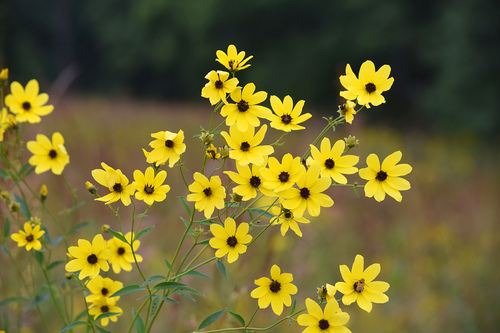


Tall Coreopsis
coreopsis tripteris
Tall Coreopsis (Coreopsis tripteris) is a stately, native North American perennial wildflower that stands out for its exceptional height and late-summer brilliance. Belonging to the aster family, this robust plant typically towers over neighboring prairie vegetation, producing dense clusters of sunny yellow, daisy-like blossoms that bloom from mid-summer into early autumn. It is highly valued in habitat restoration projects and native gardens alike because of its incredible resilience, low-maintenance nature, and outstanding ability to support diverse pollinator populations during the late season.
Hábitat: Typically found in tallgrass prairies, open woodlands, savannas, thickets, moist meadows, and along sunny roadsides.
This towering perennial reaches heights between 90 and 270 cm. It features smooth, sturdy green stems that often branch near the top. The leaves are distinctive, typically divided into three lance-shaped lobes (trifoliate), giving the foliage a delicate, airy appearance despite the plant's size. Each flower head is about 3 to 5 cm wide, sporting eight bright yellow ray florets surrounding a contrasting dark purplish-brown central disc that releases a faint, pleasant anise scent when bruised.
Categoría
PlantasRareza
Common
Peligro
1/5 · Muy bajo
Snaps
¡Sé la primera persona en hacer un snap!
Because of its imposing height, early American settlers often used wild stands of Tall Coreopsis as indicators of highly fertile prairie soil.
The scientific name 'tripteris' translates to 'three-winged', referencing the plant's characteristic deeply divided three-part leaves.
Unlike many other yellow sunflowers, the central disk of Tall Coreopsis smells distinctly of licorice or anise when crushed.
Rapidly shoots upward in late spring to outcompete neighboring grasses and maximize exposure to full sunlight.
Utilizes a deep, fibrous root system with underground rhizomes to survive droughts, wildfires, and extreme winter temperatures.
Its central discs emit an anise-like aroma that acts as a visual and olfactory beacon for beneficial pollinators while deterring certain herbivores.
As a photosynthetic plant, Tall Coreopsis produces its own food by converting sunlight, carbon dioxide, and water into chemical energy.
Synchlora aerata
The caterpillars of this moth feed on the flower buds and petals of Tall Coreopsis.
Melissodes trinodis
Native bees, particularly long-horned bees, frequently visit the flower heads for high-quality nectar and pollen.
Spinus tristis
During autumn, these birds feed heavily on the small, flat seeds produced in the dried flower heads.
Aún no hay insignias de rasgos asignadas a este objeto.
Todavía no hay alias listados.
Las colecciones para este objeto aparecerán aquí a medida que se añadan más temas.
Peligro
1/5 · Muy bajo
Todavía no hay notas especiales de seguridad.
La forma más fácil de identificar a Tall Coreopsis es usar la aplicación de identificación de naturaleza Snappit.
90-270 cm
3-10 años
As a photosynthetic plant, Tall Coreopsis produces its own food by converting sunlight, carbon dioxide, and water into chemical energy.
Typically found in tallgrass prairies, open woodlands, savannas, thickets, moist meadows, and along sunny roadsides.
Acércate para separar los grupos y explorar dónde se ha fotografiado este objeto.
Los snaps recientes aparecerán aquí a medida que se añadan nuevas observaciones.













