

Tall Green Milkweed
asclepias hirtella
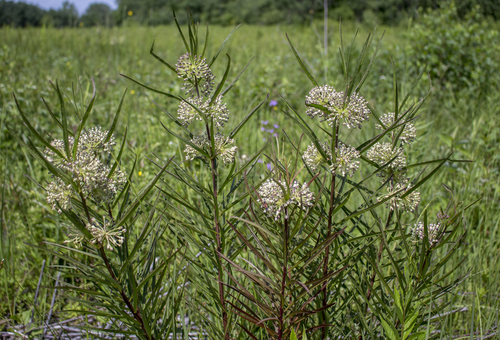
Tall Green Milkweed (Asclepias hirtella) is a robust and distinctive perennial wildflower native to the tallgrass prairies, glades, and open barrens of North America. Unlike its more famously pink-flowered cousins, this species boasts unique, pale green to yellowish clusters of flowers that blend beautifully into its grassy habitats. It grows remarkably upright and can survive in poor, sandy, or clay soils. This plant plays an important role in grassland biodiversity, supporting various insects with its rich nectar reserves while adapting to survive wildfires and droughts using its deep root system.
Hábitat: Found in tallgrass prairies, sandy barrens, glades, and open fields, often preferring dry to mesic sandy soils.
This species is distinguished by its erect, hairy stems that typically reach 50 to 100 centimeters in height. It features numerous narrow, linear leaves that are arranged alternately along the stem, a characteristic feature that differentiates it from opposite-leaved milkweeds. The pale green or creamy-white flowers have subtle purplish-green hoods and are grouped in globose clusters emerging from the upper leaf joints, which later develop into upright, smooth, spindle-shaped seed pods.
Categoría
PlantasRareza
Common
Peligro
1/5 · Muy bajo
Snaps
¡Sé la primera persona en hacer un snap!
The seeds of this species are attached to silky, white fluff that acts as a parachute, enabling wind dispersal over wide distances.
The species name 'hirtella' is Latin for 'somewhat hairy', referring to the fine, stiff hairs found on its leaves and stem.
Unlike most other milkweed species which feature opposite leaves, the Tall Green Milkweed stands out due to its alternately arranged leaves.
Produces cardenolides in its milky sap, which makes it toxic to generalist herbivores and protects it from herbivory.
Utilizes a deep, woody taproot that stores energy and accesses deep water, allowing it to withstand severe droughts and fires.
Packages its pollen into sticky, saddle-like structures called pollinia that attach to the legs of visiting insects for cross-pollination.
As a photosynthetic plant, Tall Green Milkweed produces its own energy and organic compounds using sunlight, water, carbon dioxide, and soil minerals.
Danaus plexippus
Provides essential foliage for the caterpillars, which consume the leaves and store the plant's toxins to defend themselves against predators.
Bombus pensylvanicus
Visits the green blossoms for nectar, serving as a primary pollinator of the species.
Aphis nerii
Infests the stems and leaves of the milkweed, feeding on its nutrient-rich sap.
Aún no hay insignias de rasgos asignadas a este objeto.
Todavía no hay alias listados.
Las colecciones para este objeto aparecerán aquí a medida que se añadan más temas.
Peligro
1/5 · Muy bajo
Todavía no hay notas especiales de seguridad.
La forma más fácil de identificar a Tall Green Milkweed es usar la aplicación de identificación de naturaleza Snappit.
50-100 cm
3-15 años
As a photosynthetic plant, Tall Green Milkweed produces its own energy and organic compounds using sunlight, water, carbon dioxide, and soil minerals.
Found in tallgrass prairies, sandy barrens, glades, and open fields, often preferring dry to mesic sandy soils.
Acércate para separar los grupos y explorar dónde se ha fotografiado este objeto.
Los snaps recientes aparecerán aquí a medida que se añadan nuevas observaciones.