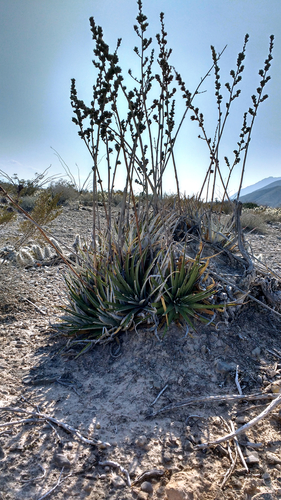


Texas False Agave
hechtia texensis
Hechtia texensis, commonly known as Texas false agave, is a striking terrestrial bromeliad native to the arid limestone cliffs and rocky slopes of the Chihuahuan Desert, particularly in the Big Bend region of Texas and northern Mexico. Unlike most bromeliads which are epiphytes growing on trees, this tough survivor anchors its roots directly into rock crevices. It forms dense, low-growing rosettes of heavily armed, succulent leaves that deter herbivores and conserve vital moisture in harsh, sun-baked environments. During the blooming season, the Texas false agave sends up tall, slender flower stalks bearing clusters of small, creamy white flowers. It is dioecious, meaning individual plants are either male or female. This remarkable plant provides critical erosion control on steep desert slopes and serves as an important microhabitat for small desert fauna, showcasing the incredible adaptability of the Bromeliaceae family to extreme arid climates.
Hábitat: Found on dry, sun-baked limestone cliffs, rocky ledges, and steep canyons in desert scrub ecosystems.
This plant features a dense, symmetrical rosette of stiff, narrow, recurved leaves that grow up to 30 to 45 centimeters long. The leaf margins are heavily armed with sharp, backward-pointing spines that can easily catch on skin or clothing. The foliage is typically a pale, dusty green to yellowish-green, but can flush with deep red or purple hues under intense sun exposure or drought stress. In late spring or summer, it produces tall, woody, branching flower stalks holding small, inconspicuous clusters of three-petaled, creamy white to greenish flowers.
Categoría
PlantasRareza
Common
Peligro
1/5 · Muy bajo
Snaps
¡Sé la primera persona en hacer un snap!
Dioecious Nature: Texas false agave plants are unisexual, meaning an individual specimen will produce either exclusively male or exclusively female flowers.
False Identity: Despite its common name 'Texas False Agave' and similar spiky appearance, it belongs to the pineapple family (Bromeliaceae) rather than the agave family.
Terrestrial Bromeliad: Unlike Spanish moss or tropical air plants in its family, this bromeliad lives strictly on the ground, anchoring itself firmly into solid rock.
To conserve precious water, the plant opens its stomata at night to absorb carbon dioxide, storing it for use during the dry, scorching daytime.
The leaf margins are lined with sharp, recurved teeth that effectively deter larger herbivores from consuming the plant's moisture-rich succulent leaves.
When subjected to extreme solar radiation and drought, the leaves produce protective anthocyanin pigments, turning a brilliant deep red.
As a photosynthetic plant, the Texas false agave manufactures its own energy using sunlight, water, carbon dioxide, and minimal nutrients from rock crevices.
Pecari tajacu
Collared Peccaries occasionally forage on the tender base or root systems of young plants despite the formidable leaf spines.
Apis mellifera
Honey bees visit the small clusters of flowers during the spring and summer months to collect nectar, acting as pollinators.
Aún no hay insignias de rasgos asignadas a este objeto.
Todavía no hay alias listados.
Las colecciones para este objeto aparecerán aquí a medida que se añadan más temas.
Peligro
1/5 · Muy bajo
Todavía no hay notas especiales de seguridad.
La forma más fácil de identificar a Texas False Agave es usar la aplicación de identificación de naturaleza Snappit.
30-60 cm
1-5 kg
15-40 años
As a photosynthetic plant, the Texas false agave manufactures its own energy using sunlight, water, carbon dioxide, and minimal nutrients from rock crevices.
Found on dry, sun-baked limestone cliffs, rocky ledges, and steep canyons in desert scrub ecosystems.
Acércate para separar los grupos y explorar dónde se ha fotografiado este objeto.
Los snaps recientes aparecerán aquí a medida que se añadan nuevas observaciones.













