

Texas Madrone
arbutus xalapensis
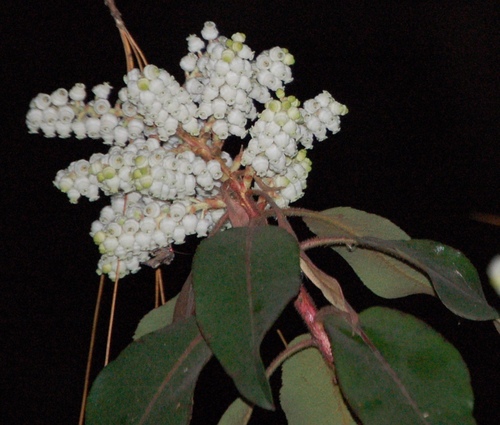
The Texas Madrone (Arbutus xalapensis) is an enchanting evergreen tree native to the rocky, limestone-rich soils of the southwestern United States and Mexico. Renowned for its striking, multi-colored peeling bark, this tree exposes smooth, polished trunk surfaces underneath that range from cream to deep hues of coral and red—earning it the colloquial nickname "naked wood." In the spring, the tree bursts with clusters of fragrant, urn-shaped white-to-pink flowers that attract a multitude of pollinators. These blooms give way to vibrant orange and red berries in the fall, which serve as a critical food source for local wildlife. Despite its rugged beauty, the Texas Madrone is notoriously difficult to propagate and transplant, making mature wild specimens highly prized treasures for hikers and naturalists exploring Chihuahuan Desert canyons and Edwards Plateau woodlands.
Hábitat: Found in rocky limestone canyons, mountainous slopes, and oak-juniper woodlands at elevations between 3,000 and 8,000 feet.
The Texas Madrone typically grows as a small to medium-sized tree or large shrub, reaching heights of 4 to 12 meters. Its most defining characteristic is the smooth, cold-to-the-touch bark that peels away in papery layers to reveal a spectrum of inner bark colors, including peach, apricot, and deep reddish-brown. It features thick, leathery, dark-green oval leaves with smooth or slightly serrated margins. In early spring, it produces terminal panicles of small, creamy-white, lantern-like flowers, which are followed in autumn by clusters of bumpy, spherical, bright red-to-orange berries measuring about 8 to 12 millimeters in diameter.
Categoría
PlantasRareza
Common
Peligro
1/5 · Muy bajo
Snaps
¡Sé la primera persona en hacer un snap!
Its wood is incredibly dense, heavy, and hard, making it historically sought after for tool handles and charcoal, though cutting it is discouraged due to its rarity in the US.
Locals often refer to the Texas Madrone as 'lady's leg' or 'naked wood' because the peeling bark reveals a remarkably smooth, pinkish trunk underneath.
Unlike most evergreen trees, the Texas Madrone can photosynthesize through its bark when its leaves are stressed or shedding, thanks to chlorophyll present in the smooth reddish-orange trunk layers.
Regularly sheds its outer bark, which helps prevent epiphytic plants and mosses from growing on it, while also allowing some photosynthesis to occur directly through its smooth under-bark.
Possesses thick, leathery leaves with a waxy cuticle that minimizes water loss, allowing the tree to thrive in arid limestone environments.
Relies on specialized underground fungal networks to absorb scarce nutrients and moisture from rocky, poor soils where its roots struggle to establish alone.
As a photoautotrophic plant, the Texas Madrone produces its own energy via photosynthesis, utilizing sunlight, carbon dioxide, and water while absorbing essential soil nutrients.
Bombycilla cedrorum
Feeds heavily on the ripe red berries of the Texas Madrone during its autumn and winter migrations, assisting in seed dispersal.
Apis mellifera
Visits the fragrant urn-shaped flowers in early spring to collect nectar, acting as a primary pollinator.
Arbutaceae mycorrhizae
Forms obligate mycorrhizal associations with specialized soil fungi to secure minerals and water in limestone soils.
Aún no hay insignias de rasgos asignadas a este objeto.
Todavía no hay alias listados.
Las colecciones para este objeto aparecerán aquí a medida que se añadan más temas.
Peligro
1/5 · Muy bajo
Todavía no hay notas especiales de seguridad.
La forma más fácil de identificar a Texas Madrone es usar la aplicación de identificación de naturaleza Snappit.
400-1200 cm
50-150 años
As a photoautotrophic plant, the Texas Madrone produces its own energy via photosynthesis, utilizing sunlight, carbon dioxide, and water while absorbing essential soil nutrients.
Found in rocky limestone canyons, mountainous slopes, and oak-juniper woodlands at elevations between 3,000 and 8,000 feet.
Acércate para separar los grupos y explorar dónde se ha fotografiado este objeto.
Los snaps recientes aparecerán aquí a medida que se añadan nuevas observaciones.