Texas Ragwort
senecio ampullaceus
The Texas Ragwort, also known as Texas Groundsel, is a vibrant annual wildflower endemic to the sandy soils of Texas and surrounding regions. Emerging in early spring, it blankets fields, open woodlands, and roadsides in a stunning sheet of golden-yellow blooms. This resilient plant is well-adapted to the well-drained, sandy environments of the Gulf Coast and post oak savannahs, providing an essential early-season food source for local pollinators when few other plants are in bloom. While beautiful, the plant contains toxic compounds that protect it from most mammalian herbivores, allowing it to thrive undisturbed in pastures. It stands as a classic symbol of the Texan spring landscape, heralding the end of winter with its brilliant, cheerful color.
Hábitat: Typically found in open sandy areas, post oak savannahs, prairies, and disturbed roadsides.
Texas Ragwort typically grows between 20 to 80 centimeters tall, featuring single or clustered upright stems. It is easily identified by its soft, fleshy, bluish-green leaves that clasp the stem directly, with the lower leaves being larger and more oval-shaped. The flowering heads are clustered at the top of the stem, each boasting a bright yellow central disk surrounded by 8 to 15 matching yellow ray petals. Before opening, the flower buds exhibit a distinctive, slightly swollen flask-like shape, which gives the species its scientific name.
Categoría
PlantasRareza
Common
Peligro
1/5 · Muy bajo
Snaps
¡Sé la primera persona en hacer un snap!
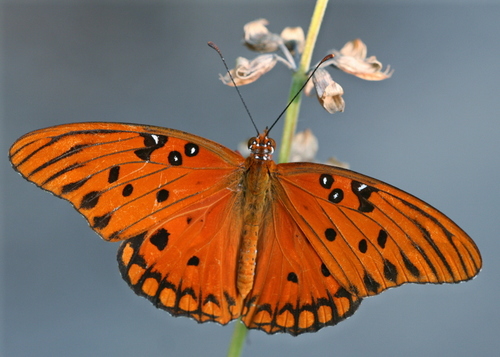
Despite being toxic to livestock, it is highly beneficial to native bees and butterflies as an early-season nectar source.
It is a true regional specialty, being almost entirely restricted to the state of Texas.
The species name 'ampullaceus' comes from the Latin word for flask, referring to the flask-shaped buds of the plant.
Produces pyrrolizidine alkaloids that are highly toxic to liver cells, deterring grazing mammals like cattle and horses from consuming it.
Blooms rapidly in early spring, capitalizing on early-season moisture and avoiding competition with later-emerging summer plants.
Utilizes a specialized taproot system to anchor firmly and extract moisture from fast-draining, nutrient-poor sandy soils.
As an autotrophic plant, Texas Ragwort creates its own energy through photosynthesis, using sunlight, water, and atmospheric carbon dioxide.
Bombus pensylvanicus
Feeds on the nectar and pollen, acting as a major early-season pollinator.
Danaus plexippus
Utilizes the abundant spring blooms as a crucial energy source during its spring migration.
Odocoileus virginianus
Occasionally browses the young foliage, though generally avoids older toxic leaves.
Aún no hay insignias de rasgos asignadas a este objeto.
Todavía no hay alias listados.
Las colecciones para este objeto aparecerán aquí a medida que se añadan más temas.
Peligro
1/5 · Muy bajo
Todavía no hay notas especiales de seguridad.
La forma más fácil de identificar a Texas Ragwort es usar la aplicación de identificación de naturaleza Snappit.
20-80 cm
1 años
As an autotrophic plant, Texas Ragwort creates its own energy through photosynthesis, using sunlight, water, and atmospheric carbon dioxide.
Typically found in open sandy areas, post oak savannahs, prairies, and disturbed roadsides.
Acércate para separar los grupos y explorar dónde se ha fotografiado este objeto.
Los snaps recientes aparecerán aquí a medida que se añadan nuevas observaciones.