

Texas Yellow Star
lindheimera texana
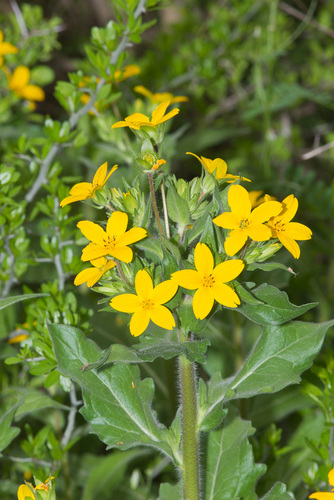
The Texas Yellow Star (Lindheimera texana) is a cheerful, low-growing annual wildflower native to the US Southwest, primarily Texas, and parts of Northern Mexico. Emerging in early spring, this species carpet-bombs prairies, pastures, and roadsides with dense, radiant yellow blooms. It is named after Ferdinand Jacob Lindheimer, widely known as the father of Texas botany. As a member of the sunflower family (Asteraceae), it plays a crucial role in supporting early-season pollinators, providing much-needed nectar to native bees and butterflies when few other flowers have opened. Its resilience in dry, clay soils and its rapid life cycle make it a quintessential spring signpost in its native range.
Hábitat: Found in open prairies, limestone glades, clay soils, and disturbed roadsides throughout Texas and neighboring regions.
Texas Yellow Star is characterized by its five-petaled star-shaped flower heads, which are bright golden-yellow and roughly 2.5 to 3 cm across. Each of the five ray florets features distinct, small notches at their tips, surrounding a central disk of matching yellow florets. The stems are hairy, branching, and erect, reaching heights between 15 and 45 cm. The leaves are coarsely textured, lance-shaped to ovate, and arranged alternately along the upper stem while being opposite near the base, often showing slightly toothy margins.
Categoría
PlantasRareza
Common
Peligro
1/5 · Muy bajo
Snaps
¡Sé la primera persona en hacer un snap!
Each flower head consistently features exactly five ray petals, giving them their characteristic star shape.
The seeds of the Texas Yellow Star require a period of cold stratification during winter to successfully germinate the following spring.
The species was named to honor Ferdinand Lindheimer, a prolific German-Texan botanist who collected thousands of Texas plant specimens.
Possesses a sturdy taproot and adapted foliage that conserve moisture, allowing the plant to thrive and bloom even in dry, rocky clay soils.
Produces numerous lightweight seeds that are easily dispersed by the wind, ensuring successful regeneration in the following spring.
Emits UV-reflective nectar guides on its bright yellow petals that are highly visible to bees, directing them efficiently to the pollen source.
As a photoautotrophic plant, the Texas Yellow Star synthesizes its own energy from sunlight, water, and carbon dioxide through the process of photosynthesis.
Bombus pensylvanicus
Visits the flowers for nectar and pollen, facilitating cross-pollination.
Odocoileus virginianus
Occasionally grazes on the young foliage of the plant in early spring.
Taraxacum officinale
Competes for soil nutrients, sunlight, and space in grassy pastures and roadsides.
Aún no hay insignias de rasgos asignadas a este objeto.
Todavía no hay alias listados.
Las colecciones para este objeto aparecerán aquí a medida que se añadan más temas.
Peligro
1/5 · Muy bajo
Todavía no hay notas especiales de seguridad.
La forma más fácil de identificar a Texas Yellow Star es usar la aplicación de identificación de naturaleza Snappit.
15-45 cm
0.01-0.05 kg
0-1 años
As a photoautotrophic plant, the Texas Yellow Star synthesizes its own energy from sunlight, water, and carbon dioxide through the process of photosynthesis.
Found in open prairies, limestone glades, clay soils, and disturbed roadsides throughout Texas and neighboring regions.
Acércate para separar los grupos y explorar dónde se ha fotografiado este objeto.
Los snaps recientes aparecerán aquí a medida que se añadan nuevas observaciones.

















.jpg&width=800)

