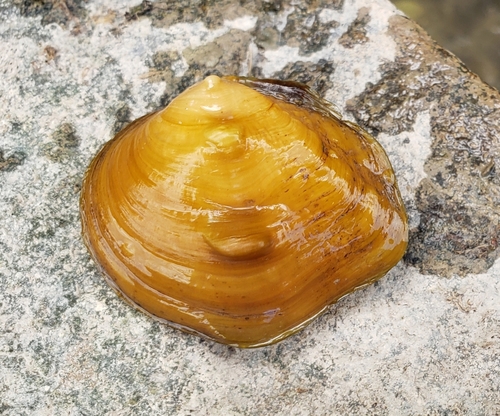


Three-Horn Wartyback
obliquaria reflexa
The Three-Horn Wartyback (Obliquaria reflexa) is a fascinating freshwater mussel native to the river systems of North America, particularly the Mississippi River Basin. Named for the distinct, alternating row of prominent knobs running down its thick shell, this species looks like a tiny, armored river-dweller. As a filter feeder, it plays a vital ecological role by purifying water, making it an unsung hero of aquatic ecosystems. Like many freshwater mussels, the Three-Horn Wartyback possesses an incredibly unique life cycle that involves a temporary parasitic stage. Its microscopic larvae, called glochidia, must attach to the gills or fins of specific host fish to develop into juvenile mussels. This remarkable evolutionary strategy allows the relatively sedentary mussel to disperse far and wide across river networks, hitching rides on fast-moving fish before dropping off to begin its life in the riverbed.
Hábitat: Found primarily partially buried in the sand and gravel substrates of medium to large rivers with moderate currents.
This medium-sized mussel typically grows up to 8 centimeters in length and is easily identified by its thick, somewhat rounded, and inflated shell. Its most defining characteristic is a prominent central row of 3 to 4 large, raised bumps or 'horns' that uniquely alternate in position from one valve to the other, rather than lining up symmetrically. The exterior shell color ranges from yellowish-green to brown, often patterned with faint, broken green rays, while the interior nacre (mother-of-pearl) is typically solid white and slightly iridescent.
Categoría
InvertebrateRareza
Common
Peligro
1/5 · Muy bajo
Snaps
¡Sé la primera persona en hacer un snap!
A single adult freshwater mussel can filter and clean up to 15 gallons of river water every single day.
During the late 19th and early 20th centuries, their thick, white-nacred shells were heavily harvested and punched out to make natural pearl buttons for clothing.
They rely entirely on fish to spread their young; without their specific host fish in the river system, the mussel population cannot expand.
Unlike most other bumpy mussels whose knobs line up symmetrically, the Three-Horn Wartyback's 'horns' alternate from the left shell to the right shell.
Functions as an active biofilter, siphoning gallons of water daily to extract food and consequently improving water clarity and quality in its habitat.
Utilizes specific fish species as temporary hosts for its microscopic larvae, allowing its young to be transported safely across vast river networks.
Grows thick, alternating knobs on its valves which provide structural reinforcement against strong river currents and crushing forces from predators.
Relies entirely on filter feeding to strain microscopic plant and animal matter from the water column.
Diferencias por edad: During the larval stage (glochidia), it absorbs nutrients directly from a host fish; as an adult, it filter feeds independently.
Ondatra zibethicus
Muskrats actively hunt and eat adult freshwater mussels, often leaving distinct piles of empty shells known as middens on riverbanks.
Luxilus cornutus
Serves as a vital host species for the mussel's parasitic glochidia larvae.
Dreissena polymorpha
An invasive species that aggressively attaches to native mussels' shells, competing for resources and often suffocating them.
Aún no hay insignias de rasgos asignadas a este objeto.
Todavía no hay alias listados.
Las colecciones para este objeto aparecerán aquí a medida que se añadan más temas.
Peligro
1/5 · Muy bajo
Todavía no hay notas especiales de seguridad.
La forma más fácil de identificar a Three-Horn Wartyback es usar la aplicación de identificación de naturaleza Snappit.
3-8 cm
0.05-0.15 kg
10-30 años
Relies entirely on filter feeding to strain microscopic plant and animal matter from the water column.
Found primarily partially buried in the sand and gravel substrates of medium to large rivers with moderate currents.
Filtering
10000-95000
Acércate para separar los grupos y explorar dónde se ha fotografiado este objeto.
Los snaps recientes aparecerán aquí a medida que se añadan nuevas observaciones.