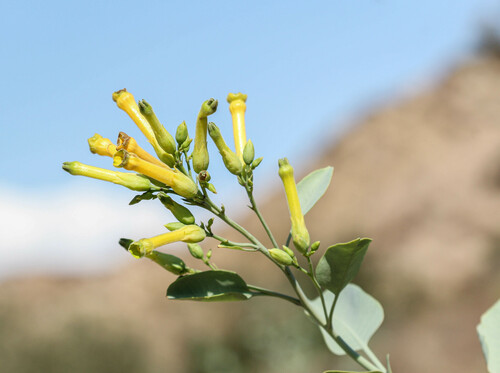


Tree Tobacco
nicotiana glauca
Tree Tobacco (Nicotiana glauca) is a fast-growing, woody shrub or small tree native to South America that has successfully naturalized in warm, arid regions globally. Characterized by its blue-green, rubbery leaves and clusters of bright yellow, tubular flowers, it is a hardy pioneer species that thrives in disturbed soils, roadsides, and riverbanks. While it belongs to the tobacco family, it is highly toxic to humans and livestock due to the presence of anabasine, an alkaloid closely related to nicotine. Despite its toxicity, Tree Tobacco plays an important ecological role, attracting various pollinators like hummingbirds with its nectar-rich flowers. Its ability to tolerate extreme drought and poor soil makes it an exceptionally resilient plant, though in many areas outside its native range, it is considered an invasive weed that outcompetes native vegetation.
Hábitat: Found in dry, disturbed habitats such as roadsides, riverbanks, waste areas, and coastal scrub.
This evergreen shrub typically grows between 2 to 6 meters tall, featuring sparse, sprawling branches with a distinct blue-gray or glaucous coating on its smooth, pale bark. Its leaves are thick, rubbery, and ovate, measuring up to 20 cm long with a striking bluish-green hue. The most identifying feature is the terminal clusters of elongated, trumpet-shaped yellow flowers, each about 3 to 5 cm long, which bloom year-round in warm climates and eventually produce small, egg-shaped seed capsules.
Categoría
PlantasRareza
Common
Peligro
1/5 · Muy bajo
Snaps
¡Sé la primera persona en hacer un snap!
Despite its common name and classification under the Nicotiana genus, Tree Tobacco does not contain significant amounts of nicotine; instead, its primary alkaloid is anabasine.
In some native South American cultures, the leaves were historically used in traditional medicine as poultices for wounds and skin conditions.
It is highly toxic to both humans and livestock, and even contact with the leaves can cause skin irritation in sensitive individuals.
The species is exceptionally good at phytoremediation, absorbing heavy metals like zinc and lead from polluted soils.
Produces the highly toxic alkaloid anabasine, which deters most herbivores and pests from feeding on its foliage.
Features thick, waxy, glaucous leaves that minimize water loss, allowing the plant to thrive in hyper-arid conditions.
Produces thousands of tiny, wind-dispersed seeds that quickly establish in disturbed, nutrient-poor soils.
As an autotrophic plant, Tree Tobacco generates its own food through photosynthesis, utilizing sunlight, water, and carbon dioxide.
Calypte anna
Feeds on the nectar and acts as a primary pollinator for the tubular flowers.
Manduca quinquemaculata
Feeds on the leaves as a larval host, tolerating the toxic alkaloids.
Apis mellifera
Visits the yellow tubular flowers to forage for nectar and pollen.
Aún no hay insignias de rasgos asignadas a este objeto.
Todavía no hay alias listados.
Las colecciones para este objeto aparecerán aquí a medida que se añadan más temas.
Peligro
1/5 · Muy bajo
Todavía no hay notas especiales de seguridad.
La forma más fácil de identificar a Tree Tobacco es usar la aplicación de identificación de naturaleza Snappit.
200-600 cm
5-15 años
As an autotrophic plant, Tree Tobacco generates its own food through photosynthesis, utilizing sunlight, water, and carbon dioxide.
Found in dry, disturbed habitats such as roadsides, riverbanks, waste areas, and coastal scrub.
Acércate para separar los grupos y explorar dónde se ha fotografiado este objeto.
Los snaps recientes aparecerán aquí a medida que se añadan nuevas observaciones.

















