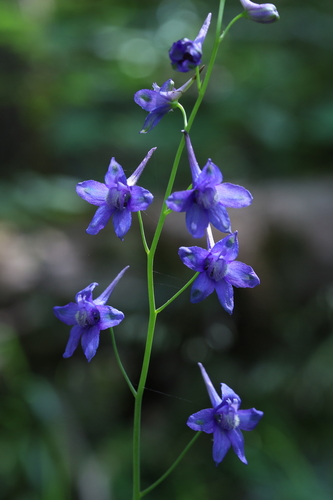


Trelease'S Larkspur
delphinium treleasei
Trelease's larkspur is a stunning perennial wildflower endemic to the glades of the Ozark region in North America. This rare plant is celebrated for its brilliant, deep blue-violet blossoms that form loose, elegant clusters atop slender stems. Blooming in late spring, it serves as an important early-season resource for native pollinators, standing out as a jewel of the rocky limestone and dolomite glades it calls home. Its restricted range and specific habitat requirements make it a prized sight for hikers and botanists alike.
Hábitat: Found exclusively in rocky limestone and dolomite glades, bald knobs, and barrens of the Ozark plateau.
This herbaceous perennial typically grows 30 to 90 cm tall, featuring deeply divided, palmately lobed leaves clustered mostly near the base. The striking spurred flowers are a deep blue to violet, characterized by a prominent backward-projecting spur that holds nectar. Each blossom has five petal-like sepals and smaller, lighter-colored true petals at the center, creating a complex, hooded appearance typical of the Delphinium genus.
Categoría
PlantasRareza
Common
Peligro
1/5 · Muy bajo
Snaps
¡Sé la primera persona en hacer un snap!
Despite its extreme toxicity to cattle and humans, its vibrant nectar is safely enjoyed by long-tongued native bumblebees and hummingbirds.
Its scientific name, Delphinium, comes from the Greek word for dolphin, referring to the shape of the flower bud before it opens.
This species is a strict Ozark endemic, meaning it is found naturally nowhere else on Earth except for a small region in Missouri and Arkansas.
Produces potent diterpenoid alkaloids throughout its tissues, making it highly toxic to most mammalian herbivores and protecting it from grazing.
Possesses a deep taproot system capable of anchoring in thin, rocky soils and surviving intense summer droughts typical of glade environments.
Features specialized floral spurs that selectively reward long-tongued pollinators, ensuring efficient, high-fidelity cross-pollination.
As a photoautotrophic plant, it produces its own energy using sunlight, water, and carbon dioxide through photosynthesis, supplemented by soil nutrients.
Bombus pensylvanicus
Feeds on the nectar of the flowers and acts as a primary pollinator.
Juniperus virginiana
Encroaches on open glades, shading out Trelease's larkspur and competing for resources.
Archilochus colubris
Visits the deep spurred flowers to feed on nectar, assisting in cross-pollination.
Aún no hay insignias de rasgos asignadas a este objeto.
Todavía no hay alias listados.
Las colecciones para este objeto aparecerán aquí a medida que se añadan más temas.
Peligro
1/5 · Muy bajo
Todavía no hay notas especiales de seguridad.
La forma más fácil de identificar a Trelease'S Larkspur es usar la aplicación de identificación de naturaleza Snappit.
30+ cm
3+ años
As a photoautotrophic plant, it produces its own energy using sunlight, water, and carbon dioxide through photosynthesis, supplemented by soil nutrients.
Found exclusively in rocky limestone and dolomite glades, bald knobs, and barrens of the Ozark plateau.
Acércate para separar los grupos y explorar dónde se ha fotografiado este objeto.
Los snaps recientes aparecerán aquí a medida que se añadan nuevas observaciones.














._Locatie_Hortus_Haren_01.jpg&width=800)

