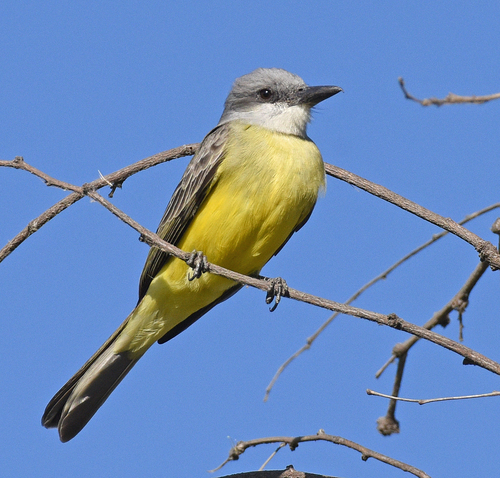


Tropical Kingbird
tyrannus melancholicus
The Tropical Kingbird is a highly conspicuous and feisty flycatcher native to the Americas. Known for its bold demeanor, this vocal bird is often seen perched high on telephone wires, exposed branches, or fences, from which it launches aerial sallies to capture flying insects. With its bright yellow underparts and contrasting gray head, it is a vibrant addition to semi-open habitats, agricultural lands, and urban parks. It gets its genus name "Tyrannus" (meaning tyrant) from its aggressive defense of its nesting territory against much larger birds, including hawks and caracaras.
Hábitat: Found in semi-open areas, agricultural lands, forest edges, and urban parks, often near water sources or elevated perches.
This medium-sized flycatcher measures around 22 cm in length and features a bright olive-green back, a pale gray head with a darker mask through the eyes, and a brilliant, solid yellow breast and belly. Its throat is a contrasting pale gray or white, and its tail is dusty brown and distinctly notched. A hidden, bright orange-red crown patch is present on its head, though it is rarely visible unless the bird is excited or engaged in a territorial display.
Categoría
AvesRareza
Common
Peligro
1/5 · Muy bajo
Snaps
¡Sé la primera persona en hacer un snap!
Despite being relatively small, Tropical Kingbirds will fearlessly attack and chase away giant raptors like Harpy Eagles and Crested Caracaras.
The scientific name 'melancholicus' was given because the early naturalist who described it thought its high, whistling call sounded sad or melancholic.
They possess a hidden orange-red patch of feathers on their crown, which they only reveal during territorial displays or when highly excited.
Exhibits incredible agility in flight, launching from high perches to snap up fast-flying insects mid-air before returning to the same spot.
Boldly defends its nesting territory by harassing and chasing away much larger predators, such as hawks, crows, and caracaras.
Flairs open its gray crown feathers to reveal a hidden, fiery orange-red crest used to intimidate rivals or attract mates.
Primarily feeds on flying insects caught mid-air, though it occasionally consumes small berries and fruits, especially during the dry season.
Diferencias por edad: Nestlings are fed exclusively high-protein insects by parents, transitioning to include some fruits as adults.
Apis mellifera scutellata
Feeds heavily on large flying insects, including the Africanized honey bee.
Molothrus bonariensis
Frequently targeted by the shiny cowbird, which lays its eggs in the kingbird's nest.
Myiozetetes similis
Competes for prime perches and aerial insect prey in overlapping territories.
Aún no hay insignias de rasgos asignadas a este objeto.
Todavía no hay alias listados.
Las colecciones para este objeto aparecerán aquí a medida que se añadan más temas.
Peligro
1/5 · Muy bajo
Todavía no hay notas especiales de seguridad.
La forma más fácil de identificar a Tropical Kingbird es usar la aplicación de identificación de naturaleza Snappit.
20+ cm
37+ cm
0.032+ kg
5+ años
40 km/h
Primarily feeds on flying insects caught mid-air, though it occasionally consumes small berries and fruits, especially during the dry season.
Found in semi-open areas, agricultural lands, forest edges, and urban parks, often near water sources or elevated perches.
Acércate para separar los grupos y explorar dónde se ha fotografiado este objeto.
Los snaps recientes aparecerán aquí a medida que se añadan nuevas observaciones.









.jpg&width=800)







