

Trumpet Gooseberry
ribes leptanthum
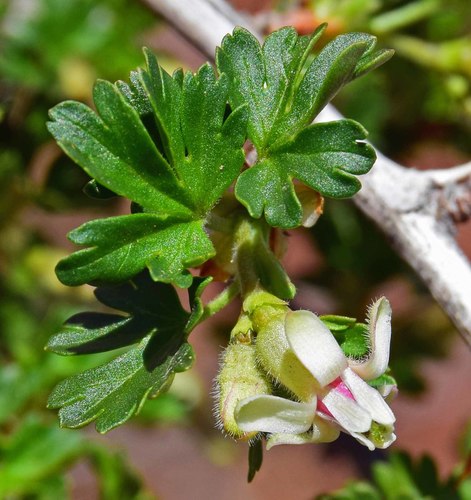
The Trumpet Gooseberry (Ribes leptanthum) is a resilient, spiny deciduous shrub native to the mountainous regions of the southwestern United States. Thriving in rocky canyons, pine-oak woodlands, and open coniferous forests, this hardy plant is easily distinguished by its slender, trumpet-shaped white to pale pink flowers that bloom in late spring. These delicate, sweet-scented blossoms provide vital nectar for early-season pollinators, while its sharp, defensive spines offer safe nesting sites for small birds. As summer wanes, the blossoms give way to deep purple-to-black berries that serve as a critical food source for local wildlife and have a rich history of traditional use by indigenous peoples.
Hábitat: Found on dry, rocky slopes, canyon bottoms, and within open coniferous forests at moderate to high elevations.
This multi-branched shrub typically grows between 50 and 200 centimeters tall, forming dense, thorny thickets. Its woody stems are armed with sharp, yellow-brown nodal spines, and the small, deeply lobed green leaves resemble miniature fan shapes with soft hairs on both sides. The highly characteristic trumpet-shaped flowers are small, about 1 to 1.5 centimeters long, featuring a tube-like calyx and spreading white or pinkish petals. After successful pollination, the plant produces round, smooth berries that mature from green to a dark, glossy purplish-black, measuring around 6 to 8 millimeters in diameter.
Categoría
PlantasRareza
Common
Peligro
1/5 · Muy bajo
Snaps
¡Sé la primera persona en hacer un snap!
Indigenous peoples, including the Navajo and Hopi, historically utilized the berries for food and crafted the straight, thorny stems into specialized tools and arrow shafts.
The specific epithet 'leptanthum' comes from Greek roots meaning 'slender-flowered', perfectly describing its elegant trumpet-like blossoms.
Unlike some other gooseberries, the berries of the Trumpet Gooseberry are smooth and bald, lacking the glandular, sticky hairs found on related species.
Developed formidable nodal spines along its woody stems to deter hungry herbivores and browse damage.
Possesses a deep, extensive root system capable of anchoring in rocky, dry soils and extracting scarce moisture.
Produces elongated, trumpet-shaped flowers specifically structured to attract long-tongued pollinators like native bees and butterflies.
As a photosynthetic plant, the Trumpet Gooseberry produces its own energy using sunlight, water, carbon dioxide, and essential soil minerals.
Selasphorus rufus
Visits the tubular flowers for nectar, facilitating pollination during its spring migration.
Ursus americanus
Consumes the ripe berries during late summer, helping disperse the seeds across wide distances.
Odocoileus hemionus
Browses on the young shoots and leaves despite the shrub's defensive spines.
Aún no hay insignias de rasgos asignadas a este objeto.
Todavía no hay alias listados.
Las colecciones para este objeto aparecerán aquí a medida que se añadan más temas.
Peligro
1/5 · Muy bajo
Todavía no hay notas especiales de seguridad.
La forma más fácil de identificar a Trumpet Gooseberry es usar la aplicación de identificación de naturaleza Snappit.
50+ cm
10+ años
As a photosynthetic plant, the Trumpet Gooseberry produces its own energy using sunlight, water, carbon dioxide, and essential soil minerals.
Found on dry, rocky slopes, canyon bottoms, and within open coniferous forests at moderate to high elevations.
Acércate para separar los grupos y explorar dónde se ha fotografiado este objeto.
Los snaps recientes aparecerán aquí a medida que se añadan nuevas observaciones.