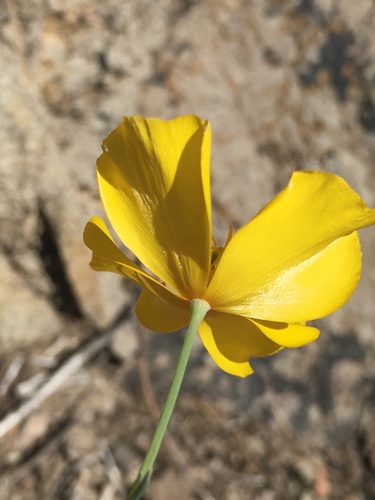


Tufted Poppy
eschscholzia caespitosa
The Tufted Poppy (Eschscholzia caespitosa) is a delicate and vibrant annual wildflower native to the western United States and Baja California. Closely related to the famous California Poppy, this charming plant distinguishes itself with its neat, tufted growth habit and smaller stature. It bursts into bloom during the spring, carpeting open grassy slopes, chaparral, and coastal sage scrub habitats with brilliant splashes of yellow and orange. As a fast-growing annual, it capitalizes on seasonal rainfall to complete its life cycle before the dry summer heat sets in. Its cheerful blossoms not only delight hikers and nature enthusiasts but also provide a crucial early-season nectar and pollen source for native bees and butterflies, making it a vital component of western scrub ecosystems.
Hábitat: Found in dry, sandy, or rocky soils across chaparral, oak woodlands, desert margins, and coastal sage scrub habitats.
This small annual herb typically grows 10 to 30 centimeters tall, featuring a basal rosette of highly dissected, fern-like leaves that are pale blue-green or grayish in color. From this leafy tuft rise slender, leafless stems topped with solitary, cup-shaped flowers. The blossoms measure 2 to 4 centimeters across and boast four satiny petals that range from bright yellow to deep orange. Unlike its close relative, the California poppy, the Tufted Poppy lacks a distinct, flared rim (torus) at the base of the flower receptacle.
Categoría
PlantasRareza
Common
Peligro
1/5 · Muy bajo
Snaps
¡Sé la primera persona en hacer un snap!
Because their flowers react to sunlight by closing in the shade, a bright field of Tufted Poppies can appear to suddenly 'disappear' when heavy clouds roll in.
If you look closely beneath the flower petals, you can easily tell the Tufted Poppy apart from the California Poppy because it lacks the distinctive 'hula skirt' rim or collar at the base.
The species name 'caespitosa' comes from the Latin word for 'tufted', directly referring to the way its lacy leaves clump densely at the base of the plant.
When the long, horn-like seed pods dry out in the early summer sun, they burst open with such incredible force that they can fling seeds several feet away.
The flowers possess the ability to close at night or on cloudy days, protecting their valuable pollen from moisture and cold temperatures.
As a winter-spring annual, it entirely avoids the harsh, dry summer by surviving as a dormant seed, perfectly timing its growth with winter rains.
The slender, horn-like seed pods dry out and split open explosively, forcefully flinging seeds away from the parent plant to reduce competition.
As a photosynthetic plant, the Tufted Poppy produces its own food by converting sunlight, water, and atmospheric carbon dioxide into energetic sugars.
Bombus vosnesenskii
Pollinated by native bumblebees foraging for early-season pollen.
Avena fatua
Competes for space, light, and soil moisture with non-native Mediterranean grasses.
Sylvilagus audubonii
Occasionally grazed upon by small herbivorous mammals in its scrubland habitat.
Aún no hay insignias de rasgos asignadas a este objeto.
Todavía no hay alias listados.
Las colecciones para este objeto aparecerán aquí a medida que se añadan más temas.
Peligro
1/5 · Muy bajo
Todavía no hay notas especiales de seguridad.
La forma más fácil de identificar a Tufted Poppy es usar la aplicación de identificación de naturaleza Snappit.
10-30 cm
1 años
As a photosynthetic plant, the Tufted Poppy produces its own food by converting sunlight, water, and atmospheric carbon dioxide into energetic sugars.
Found in dry, sandy, or rocky soils across chaparral, oak woodlands, desert margins, and coastal sage scrub habitats.
Photosynthesis
20-80
10-21 días
Acércate para separar los grupos y explorar dónde se ha fotografiado este objeto.
Los snaps recientes aparecerán aquí a medida que se añadan nuevas observaciones.





_Leucophyllum_frutescens.jpg&width=800)







