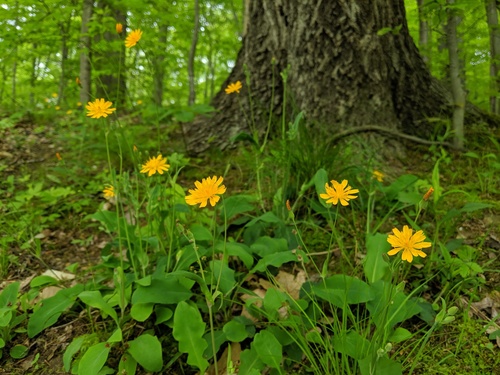


Two-Flower Dwarf-Dandelion
krigia biflora
The Two-Flower Dwarf-Dandelion is a charming perennial wildflower native to the woodlands and prairies of North America. Standing out with its vibrant orange-yellow petals, this plant brings a splash of warm color to grassy fields and open forest clearings in late spring. Despite its common name, it is not a true dandelion of the genus Taraxacum, but belongs to the genus Krigia, representing a unique lineage of North American composites. This resilient wildflower serves as an important early-season food source for various native bees, flies, and butterflies. Its ability to thrive in partial shade and sandy, acidic soils makes it a beloved sight for hikers and botanists exploring natural meadows.
Hábitat: Typically found in sandy or rocky open woodlands, oak savannas, tallgrass prairies, and forest edges.
This plant is characterized by its smooth, hairless, blue-green leaves that form a tight rosette at the base. From this rosette, slender, smooth stems rise to a height of 15 to 60 cm, typically branching near the top to support two or three vibrant orange to deep golden-yellow flower heads. Each flower head is about 2 cm wide and composed entirely of ray florets with squared-off, fringed tips.
Categoría
PlantasRareza
Common
Peligro
1/5 · Muy bajo
Snaps
¡Sé la primera persona en hacer un snap!
Its flowers open up in response to morning sunlight and close shut on overcast days or by late afternoon.
The species name 'biflora' literally translates to 'two-flowered', referring to its common habit of producing flowers in pairs.
Unlike the invasive common dandelion, this native wildflower does not spread aggressively and fits perfectly into stable ecosystems.
Exudes a bitter, white milky sap when stems are broken, deterring insect pests and herbivores from feeding on its tissues.
Features a waxy, bluish-green leaf surface that aids in moisture retention, helping the plant survive dry periods in open grasslands.
Produces multiple flowering heads per stem rather than a single flower, maximizing pollination opportunities during its bloom cycle.
As a photosynthetic autotroph, it utilizes solar energy to convert water and carbon dioxide into vital sugars.
Agapostemon virescens
Visits flowers for pollen and nectar, facilitating cross-pollination.
Odocoileus virginianus
Feeds on the nutrient-rich basal leaves of the plant.
Papilio glaucus
Visits the orange flowers for nectar, acting as an effective pollinator.
Aún no hay insignias de rasgos asignadas a este objeto.
Todavía no hay alias listados.
Las colecciones para este objeto aparecerán aquí a medida que se añadan más temas.
Peligro
1/5 · Muy bajo
Todavía no hay notas especiales de seguridad.
La forma más fácil de identificar a Two-Flower Dwarf-Dandelion es usar la aplicación de identificación de naturaleza Snappit.
15-60 cm
3-7 años
As a photosynthetic autotroph, it utilizes solar energy to convert water and carbon dioxide into vital sugars.
Typically found in sandy or rocky open woodlands, oak savannas, tallgrass prairies, and forest edges.
14-30 días
Acércate para separar los grupos y explorar dónde se ha fotografiado este objeto.
Los snaps recientes aparecerán aquí a medida que se añadan nuevas observaciones.
















